 Skip to content

Spain remains one of the most popular destinations for British expats, with over 300,000 UK nationals registered as residents in 2025. Factors including the Mediterranean lifestyle, affordable cost of living, and proximity to the UK continue to attract retirees, remote workers, and families seeking warmer climates and cultural richness.
Rules for Spanish dual citizenship with the UK changed significantly after Brexit. British nationals can no longer hold dual citizenship between Spain and the UK under standard naturalization rules. Spain requires you to renounce British citizenship when becoming a Spanish citizen through residency. However, exceptions exist for those with Spanish parents, marriage to Spanish nationals, or historical ties to Spain.
In this guide, we will explain whether Spain allows dual citizenship for UK nationals, which dual nationality options between Spain and the UK remain available, and how to stay in Spain after Brexit through residency and citizenship pathways.
Table of Contents
- Understanding Spanish Dual Citizenship for UK Nationals
- How to Stay in Spain After Brexit: Residency Options for UK Nationals
- Pathways to Spanish Citizenship for British Nationals
- Renouncing British Citizenship: What You Need to Know
- Spanish Citizenship vs Permanent Residency: Which is Right for You?
- Common Challenges and How to Overcome Them
- Frequently Asked Questions on Spanish Dual Citizenship with the UK
- Need Help Navigating Spanish Dual Citizenship with UK?
Understanding Spanish Dual Citizenship for UK Nationals
As a general rule, Spain does not recognize dual citizenship for British nationals who acquire Spanish nationality through naturalization. In most cases, a UK citizen becoming Spanish by residence must declare the renunciation of British citizenship during the Spanish nationality process, since the UK is not among the countries covered by Spain’s dual nationality exceptions.
That said, this does not cover every situation. Some people may be considered Spanish by origin from birth, rather than naturalized later, for example, if they were born to a Spanish parent and also acquired another nationality at birth under the law of the country where they were born. In cases like that, the person may be treated as having held both nationalities from birth, which is a different legal situation from that of a British national applying for Spanish citizenship by residence.
What is Dual Citizenship?
Dual citizenship, or dual nationality, means a person legally holds citizenship in two countries simultaneously. Individuals with dual nationality can vote, work, and live in both countries without visa restrictions. They hold two passports and enjoy full legal rights in each nation.
Different countries adopt different policies on dual citizenship. Some nations, like the UK and Canada, freely permit their citizens to hold multiple citizenships. Others, including Spain, impose strict limitations based on reciprocal agreements or historical ties.
Is Spanish Dual Citizenship with the UK Allowed?
No. British nationals who naturalize as Spanish citizens must renounce their British citizenship. This requirement is outlined in Article 11 of the Spanish Civil Code, which restricts dual citizenship between Spain and the UK for countries without reciprocal dual nationality treaties with Spain.
The UK, by contrast, allows its citizens to hold multiple nationalities. Britain does not require you to renounce British citizenship when acquiring Spanish nationality. However, Spain’s stricter policy means UK nationals face a choice: remain British or become Spanish, but not both under standard naturalization.
Countries Eligible for Spanish Dual Citizenship
Spain permits dual citizenship only with specific countries based on historical, cultural, or linguistic ties. These include:
Iberian Countries:
- Andorra
- Portugal
- France (under specific conditions)
Latin American Countries:
- Argentina
- Bolivia
- Brazil
- Chile
- Colombia
- Costa Rica
- Cuba
- Dominican Republic
- Ecuador
- El Salvador
- Guatemala
- Honduras
- Mexico
- Nicaragua
- Panama
- Paraguay
- Peru
- Uruguay
- Venezuela
Special Cases:
- Philippines
- Equatorial Guinea
Another special case was the Sephardic Jewish pathway. This allowed descendants of Spanish Jews expelled in 1492 to claim Spanish citizenship without renunciation. This, however, closed in 2019. British nationals with Sephardic heritage can no longer use this route.
How to Stay in Spain After Brexit: Residency Options for UK Nationals

Since Brexit took effect on 31 January 2020, UK nationals are treated as third-country nationals in Spain. Those who resided in Spain before 31 December 2020 are protected under the Withdrawal Agreement. New arrivals, on the other hand, must apply for visas like the Non-Lucrative Visa, Digital Nomad Visa, or work permits to stay in Spain legally beyond 90 days.
The Withdrawal Agreement and Your Rights
The EU-UK Withdrawal Agreement protects British nationals who were legal residents in Spain before 31 December 2020. Protected residents must apply for a TIE card (Tarjeta de Identidad de Extranjero), which proves their legal status. The application requires proof of residence before the Brexit deadline, and applicants must provide documentation such as utility bills, rental contracts, or Padrón registration.
Protected rights include access to Spain’s public healthcare system, social security benefits, and the right to work without additional permits. Family members who joined residents in Spain before the deadline also qualify for protection under the agreement.
Visa Options for UK Nationals Moving to Spain in 2026
British nationals moving to Spain after Brexit need a visa to stay longer than 90 days. There are a number of visas available, depending on eligibility and individual situations:
Non-Lucrative Visa: Suits retirees and remote workers who won’t work for Spanish employers. Requires a monthly income of at least €2,400 (2026 IPREM). The visa grants one year of residency, renewable annually, with no Spanish employment permitted under this visa.
Digital Nomad Visa: Allows remote workers employed by non-Spanish companies to live in Spain. Applicants benefit from the Beckham Law’s flat 24% tax rate on Spanish-source income for six years.
“Many UK remote workers don’t realize the Digital Nomad Visa offers significant tax advantages beyond just residency. The Beckham Law’s 24% flat tax rate can save British digital nomads thousands annually compared to Spain’s progressive income tax rates, which reach up to 47% for high earners.”
Cristina Negro, Immigration Lawyer
Work Visa: Requires a job offer from a Spanish employer or establishment of autónomo (self-employment) status. Employers must demonstrate they couldn’t fill the position with an EU national and processing takes 3-6 months.
Student Visa: For students enrolled in eligible programs in Spain. Degree and master’s students can receive authorization for the full official duration of their studies, while language students are limited to an initial one-year permit plus one one-year renewal under the rules introduced in May 2025. Students in higher education programs can also work up to 30 hours per week, provided the work is compatible with their studies.
The 90/180 Day Rule for UK Tourists
British passport holders can visit Spain visa-free for up to 90 days within a 180-day period. Starting in 2026, UK nationals will need an ETIAS authorization before entering Spain. Applications cost €7, are typically approved within minutes, and will remain valid for 3 years. Overstaying carries fines up to €10,000, deportation, and entry bans of 1-5 years across all Schengen countries.
Pathways to Spanish Citizenship for British Nationals
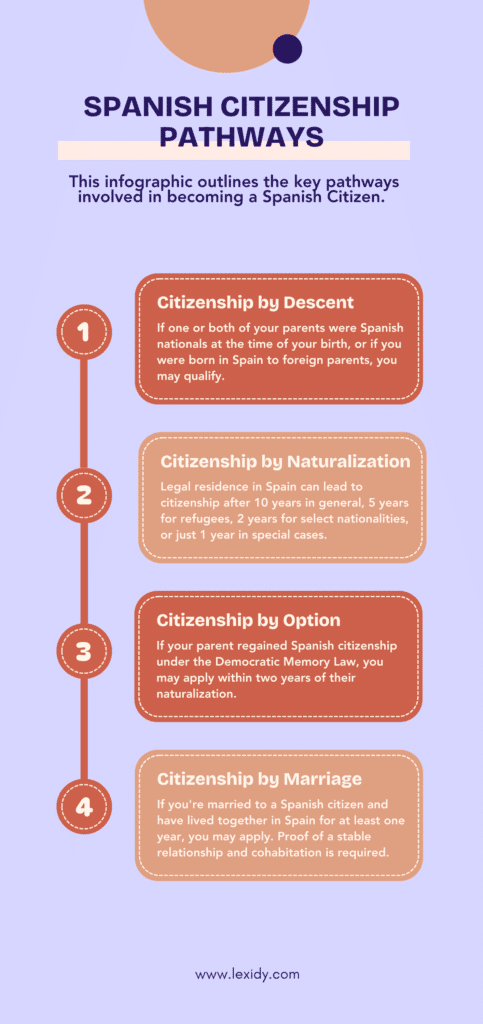
British nationals can obtain Spanish citizenship through four main routes, which are broken down in more detail below. Each pathway requires passing the DELE A2 language test and CCSE cultural knowledge exam, except for descent cases.
Citizenship Through Naturalization (10 Years)
The standard path to Spanish citizenship requires 10 years of continuous legal residency in Spain. Residents must hold valid residency permits throughout this period, with no absences exceeding 6 months per year. Residence time begins from the date the first residency permit was issued, not from when applicants entered Spain.
After 10 years, you can apply for citizenship by presenting proof of residency, passing the DELE A2 Spanish language exam and CCSE cultural knowledge test, demonstrating financial stability, and providing a clean criminal record from the UK and Spain. Processing typically takes 1-3 years from application submission.
Understanding which citizenship pathway applies to your situation requires careful analysis of your residency history, family connections, and documentation. Our Spanish citizenship services help UK nationals determine eligibility and navigate the application process efficiently.
Citizenship Through Marriage (1 Year)
British nationals married to Spanish citizens can apply for Spanish citizenship after just 1 year of legal residency in Spain. The marriage must be registered in Spain, and requires proof that the relationship is genuine through joint financial documents, evidence of shared residence, and family ties.
Applicants still need to pass the DELE A2 and CCSE exams. The 1-year residency clock starts from the first legal residence permit, not from the marriage date. Couples living together under registered civil partnerships (pareja de hecho) do not qualify for this accelerated route, only legally married spouses are eligible.
Citizenship by Descent
Those with a Spanish parent or grandparent, may qualify for Spanish citizenship through descent. Children of Spanish citizens can claim citizenship regardless of where they were born. This route does not require residency in Spain or renunciation of British citizenship in many cases, particularly for those born to Spanish parents.
Grandchildren of Spanish citizens face more complex requirements and typically must first establish residency in Spain. Citizenship-by-descent applicants need birth certificates, documentation of parents’ or grandparents’ Spanish citizenship, and proof of the family relationship chain. Language and cultural exams are usually waived for direct descendants.
Citizenship by Option (Under 20s)
Individuals under 20 years old with specific connections to Spain can apply for citizenship by option (opción). This includes those born in Spain to foreign parents if at least one parent was also born in Spain, children adopted by Spanish citizens, and those under Spanish legal guardianship for at least 2 years.
The option route is faster than naturalization, typically processing within 6-12 months, and does not always require renunciation of other citizenships. Applicants must declare their wish to acquire Spanish citizenship before age 20 and meet basic residency or connection requirements.
Renouncing British Citizenship: What You Need to Know
When becoming a Spanish citizen, Spain requires you to formally renounce your British citizenship. This is a permanent decision. You cannot automatically reclaim UK citizenship later. You must declare renunciation before Spanish authorities, though the UK Home Office also has its own process for those wishing to officially renounce.
The Renunciation Process
Spanish law generally requires applicants who acquire Spanish nationality by residence to declare that they renounce their previous nationality, unless they fall within a legally exempt category.
For British nationals, this declaration forms part of the Spanish nationality process. It is separate from any formal renunciation of British citizenship under UK law.
In practice, some people maintain Spanish dual citizenship with UK by completing the declaration required during the Spanish nationality process while continuing to hold and renew their UK passport separately.
Need guidance on gaining Spanish nationality without losing your UK citizenship? Lexidy’s experienced team of citizenship lawyers can help you understand your options, avoid common mistakes, and move through the process with more clarity and confidence.
Consequences of Renouncing UK Citizenship
Renouncing British citizenship means you lose all rights associated with UK nationality. You can no longer use a British passport for travel, vote in UK elections, or access UK consular assistance abroad. You lose the automatic right to live in the UK. Going forward, you’ll need visas to visit or work in Britain.
Your UK National Insurance contributions and state pension eligibility remain protected under reciprocal agreements between Spain and the UK. Family members are not affected by your renunciation.
Can You Reclaim British Citizenship Later?
In some cases, yes. A former British citizen who renounced British citizenship may later be able to resume it through registration rather than naturalization. Where the renunciation was made to keep or acquire another citizenship, UK guidance states that there is usually a one-time right to be registered again as a British citizen. In other cases, the decision may be discretionary. Because fees and procedures can change, they should always be checked against the latest Home Office guidance before applying.
Spanish Citizenship vs Permanent Residency: Which is Right for You?

Permanent residency allows you to live indefinitely in Spain while keeping British citizenship. Spanish citizenship provides full rights, including voting and EU freedom of movement, but requires renouncing UK nationality. After 5 years of legal residence, you can apply for permanent residency. Citizenship requires 10 years.
| Factor | Spanish Citizenship | Permanent Residency |
| Keep UK Citizenship | No – must renounce | Yes – retain UK passport |
| Residency Requirement | 10 years (1 year if married) | 5 years continuous |
| Voting Rights | Yes – all elections | Local elections only |
| EU Freedom of Movement | Yes – live/work in any EU country | Limited – Spain only |
| Spanish Passport | Yes | No – TIE card only |
| Renewal Required | No – permanent status | Yes – every 5-10 years |
| Work Rights | Full rights | Full rights in Spain |
Benefits of Spanish Citizenship
Spanish citizenship provides unrestricted access to all 27 EU member states for living, working, and studying. Spanish citizens hold a Spanish passport offering visa-free access to 186-192 countries as of 2026. Political participation extends to municipal, regional, national, and European Parliament elections.
Spanish citizens can run for office and access government positions restricted to nationals. Your children gain automatic Spanish citizenship and full EU mobility rights from birth. Citizenship eliminates administrative renewal requirements. Once citizenship is granted, your status is permanent.
Benefits of Permanent Residency
Permanent residency preserves your British citizenship while securing indefinite Spanish residence rights. You maintain access to UK consular protection, British pension rights, and the ability to return to live in the UK without visa applications. The 5-year pathway is faster than the 10-year citizenship route, and you bypass the DELE A2 Spanish language exam and CCSE cultural knowledge test.
Work and business rights within Spain match those of citizens. Healthcare, education, and social security benefits are identical to those of Spanish citizens for domestic purposes. Permanent residency remains revocable only through extended absence (more than 6 consecutive months or 10 total months per year outside Spain) or serious criminal activity.
Common Challenges and How to Overcome Them
The most common challenges UK nationals face include navigating post-Brexit bureaucracy, gathering apostilled documents, passing language exams, and understanding the renunciation requirement.
Document Apostille and Translation Requirements
All UK documents submitted for Spanish residency or citizenship applications must carry an apostille stamp from the UK Foreign, Commonwealth & Development Office. Processing takes 3-5 business days for standard service or same-day for expedited requests, costing £75 per document. Common documents requiring apostilles include birth certificates, marriage certificates, police clearance certificates, and educational diplomas.
After apostilling, documents must be officially translated into Spanish by a sworn translator (traductor jurado) registered with Spain’s Ministry of Foreign Affairs. Translations cost €30-€60 per page. Allow 5-10 business days for completion.
“Post-Brexit documentation requirements have become significantly more complex. We regularly see applications rejected because the apostille was obtained before the document was certified, or translations by non-Ministry translators. These technical errors can delay citizenship applications by 6-12 months.”
Mónica Isern López, Head of Immigration Spain
Language Exam Preparation
The DELE A2 exam tests basic Spanish conversational ability across reading, writing, listening, and speaking sections. The exam costs €130 and is offered 4-6 times annually at Instituto Cervantes locations. Pass rates for native English speakers average 78% with adequate preparation. 3-6 months should be sufficient for exam preparation if you have basic Spanish knowledge.
The CCSE cultural knowledge exam covers the Spanish government structure, history, geography, and social customs. This 25-question multiple-choice test costs €85 and requires a 60% passing score. Book both exams early because popular test centers fill 2-3 months in advance.
Navigating Processing Delays
Spanish citizenship applications are officially processed within 12 months, but actual timelines range from 18-36 months depending on application volume and regional variations. Madrid and Barcelona offices face the longest delays. You can check your application status regularly through the Spanish Ministry of Justice online portal.
Missing documents cause 60% of processing delays, according to Spanish immigration lawyers. Double-check that every required document is included, properly apostilled, translated, and dated within validity periods. Police clearance certificates expire after 3 months, so time their issuance carefully.
Working with Immigration Lawyers
Immigration lawyers specializing in UK-Spain matters understand post-Brexit requirements and regional documentation variations. Lawyers handle document gathering, apostille coordination, and official translations through their established networks.
Legal representation proves most valuable when complications arise. If Spanish authorities request additional documentation or issue a preliminary denial, lawyers can negotiate directly with civil registries and immigration offices. Choose lawyers registered with Spanish bar associations (Colegio de Abogados) who specialize in immigration law.
Our Spanish immigration team has extensive experience guiding UK nationals through post-Brexit applications, from initial visa applications to final citizenship approval.
Frequently Asked Questions on Spanish Dual Citizenship with the UK

Does Spain Allow Dual Citizenship with the UK?
No. Spain does not allow dual citizenship for UK nationals. When you become a Spanish citizen through naturalization, you must formally renounce your British citizenship.
Can I Stay in Spain After Brexit Without a Visa?
You can visit Spain visa-free for up to 90 days within a 180-day period as a tourist. Living in Spain beyond 90 days requires a visa, such as the Non-Lucrative Visa, Digital Nomad Visa, or work permit.
How Long Does It Take to Get Spanish Citizenship?
The standard pathway requires 10 years of continuous legal residency before applying, with processing taking an additional 12-36 months. If married to a Spanish citizen, you can apply after 1 year of legal residency.
What is the difference between a TIE Card and Permanent Residency?
A TIE card is your physical residency permit proving legal residence in Spain. Permanent residency is a status granted after 5 years of continuous legal residence, giving you indefinite residence rights.
Can My Children Have Dual Spanish-British Citizenship?
Children born to Spanish parents can hold dual Spanish-British citizenship regardless of birthplace. If you naturalize as a Spanish citizen after renouncing UK citizenship, children born afterward typically acquire only Spanish citizenship.
What Happens to My UK Pension if I Become Spanish?
Your UK state pension and National Insurance contributions remain protected after becoming Spanish. The UK-Spain social security agreement ensures years worked in Britain count toward your pension.
Need Help Navigating Spanish Dual Citizenship with UK?
Spanish dual citizenship for UK citizens is not permitted under standard naturalization rules. British nationals must renounce UK citizenship after 10 years of residency. However, permanent residency after 5 years offers indefinite residence rights while keeping your British passport. Choosing between citizenship and permanent residency depends on your long-term plans and ties to both countries.
Post-Brexit immigration requires precise documentation, apostilles, translations, and timing. Lexidy’s immigration lawyers guide UK nationals through Spanish residency and citizenship applications, handling complex requirements and preventing costly delays. Schedule a citizenship consultation to clarify your pathway and ensure your application meets current standards set by the Spanish authorities. All you have to do to get started is fill in the form below!