 Skip to content

2026 is a critical year for British expats living in Portugal. The first 5-year Brexit residence cards issued to UK nationals under the EU-UK Withdrawal Agreement are now expiring. Those who received their cards in 2020 or 2021 should begin preparing for renewal.
UK citizens who were living in Portugal before 31 December 2020 continue to hold protected rights under the Withdrawal Agreement, but their residence cards now need to be renewed. Meanwhile, anyone planning to move to Portugal today must apply for a visa under the current immigration rules.
This guide explains residency in Portugal for UK citizens in both situations. It covers Brexit card renewals through AIMA’s new 2026 portal, upgrading to permanent residency, the path to Portuguese citizenship, and the D7 Visa option for new arrivals.
Table of Contents
- UK Citizens in Portugal: Understanding Your Status Post-Brexit
- Brexit Residence Card Renewals in Portugal 2026
- Upgrading to Permanent Residency: What 5 Years Gets You
- Portuguese Citizenship for UK Nationals: 2026 Update
- Portugal D7 Visa Requirements (2026 Update)
- Portugal D7 Visa Application Process
- Frequently Asked Questions About Residency in Portugal for UK Citizens
- Need Legal Help Applying for Residency in Portugal for UK Citizens?
UK Citizens in Portugal: Understanding Your Status Post-Brexit

If you lived in Portugal before 31 December 2020, you’re protected under the EU-UK Withdrawal Agreement. You should hold a residence card marked “Acordo de Retiro” or “Article 50 TUE“. If you moved after Brexit, you’re a third-country national and need a visa. These are entirely different legal pathways with different rights.
Withdrawal Agreement Beneficiaries: Who Qualifies?
You qualify as a Withdrawal Agreement (WA) beneficiary if you were legally resident in Portugal on or before 31 December 2020. This includes people who were working, studying, self-employed, or economically self-sufficient on that date. Family members of qualifying UK nationals are also protected, even if they are not British themselves.
Your residence card should be marked “Acordo de Retiro” (Withdrawal Agreement) or reference “Article 50 TUE“. If your card carries this marking, your rights are protected by an international treaty. They cannot be unilaterally removed by either the UK or Portuguese government. Approximately 54,000 UK citizens have residency in Portugal under the Withdrawal Agreement in Portugal before the December 2020 deadline.
Third-Country Nationals: UK Citizens Moving After Brexit
If gained residency in Portugal as a UK citizen after 31 December 2020, you have no automatic right to reside. You are treated as a third-country national, the same as a US or Australian citizen. This means you need a valid Portuguese visa to establish residency.
The most common options for UK residents moving to Portugal after Brexit are the D7 Passive Income Visa, the Digital Nomad Visa (D8), and the Golden Visa. Each has different income thresholds, physical presence requirements, and pathways to permanent residency. The D7 is the most popular route for retirees and those with passive income. It is covered in full further on in this guide.
How to Check Your Status
The fastest way to confirm your status is to check your current residence card. Look for one of the following:
- “Acordo de Retiro“ or “Article 50 TUE“, you are a Withdrawal Agreement beneficiary with protected rights
- “Autorização de Residência“ with no Withdrawal Agreement reference, you entered via the standard visa route
- No card, if you moved after Brexit and have not yet applied, you are not a legal resident
If you are unsure, check with AIMA (Agência para a Integração, Migrações e Asilo), the Portuguese immigration authority that replaced SEF in 2023. You can also request a certificate of registration from your local council (Junta de Freguesia) as supporting documentation. UK residents in Portugal who registered before the deadline but never received a physical card should contact AIMA directly to regularise their status before renewal deadlines apply.
Brexit Residence Card Renewals in Portugal 2026
The first 5-year Brexit residence cards issued in 2020–2021 are now expiring. AIMA launched a new online portal in January 2026 to handle renewals. Apply at least 2 months before your card expires. Upon renewal, you’ll receive a card confirming permanent residence status, as all Withdrawal Agreement beneficiaries have now completed 5 or more years of legal residence.
When Does Your Brexit Card Expire?
Your expiry date is printed on the front of your residence card. Cards issued in 2020 already expired in 2025. Cards issued in 2021 will expire in 2026. If your card expired in 2025 and you have not yet renewed, you are already overdue and should contact AIMA immediately.
UK residents who are unsure of their exact expiry date can verify it through the AIMA online portal using their card number and NIF (Número de Identificação Fiscal). Do not wait for a renewal reminder. AIMA does not send automatic notifications when your card is approaching expiry.
The New AIMA Online Renewal Portal (2026)
AIMA replaced the previous SEF system in 2023. In January 2026, it launched a dedicated online renewal portal specifically for Withdrawal Agreement beneficiaries. This removed the need to attend an in-person appointment for standard renewals. The process is as follows:
- Create or log in to your AIMA portal account at aima.gov.pt using your NIF and existing card number
- Select “Renewal > Withdrawal Agreement” from the residence permit options
- Upload your required documents (see checklist below) in PDF format
- Pay the renewal fee online (currently €72.00 for WA beneficiaries), the same rate as EU citizens
- Submit your application and save your confirmation reference number
- Await biometric appointment. AIMA will contact you by email to attend a local service centre for fingerprinting and photo capture
- Collect your new card or receive it by post, depending on your local AIMA office
Keep your confirmation reference number safe. It serves as proof that your renewal is in progress while your application is being processed.
Required Documents for Renewal
Prepare the following documents before starting your online application. Incomplete submissions are a leading cause of delays.
- Valid UK passport (or copy if your passport has expired, see note below)
- Current Brexit residence card (“Acordo de Retiro“)
- Recent passport-sized photograph
- Proof of address in Portugal – utility bill, bank statement, or Atestado de Residência from your Junta de Freguesia, dated within 3 months
- NIF confirmation document
- Proof of continued residence. This can include tax returns, social security records, employment contracts, or bank statements showing activity in Portugal
- Criminal record certificate from Portugal (Registo Criminal), available online via the Portuguese Ministry of Justice portal
- Criminal record certificate from the UK, issued by the DBS (Disclosure and Barring Service), and apostilled
Note on expired UK passports: AIMA accepts expired UK passports for WA renewal applications, provided the passport was valid at the time of your original registration. Carry a certified copy alongside your current travel document.
Processing Times and AIMA Backlogs
AIMA inherited a significant backlog from SEF. As of early 2026, standard WA renewal processing times range from 3 to 6 months from submission to card collection. Complex cases, including those with gaps in residence records or missing documentation, can take longer.
While your renewal is pending, your rights are protected. A submitted and acknowledged renewal application maintains your legal residence status under Article 18(3) of the Withdrawal Agreement. Carry your confirmation reference number and your expired card together as proof of status. This is accepted by Portuguese authorities, employers, and most banks during the processing period.
“The most common mistake we see is clients waiting too long to begin their renewal. AIMA processing times are running at 3 to 6 months, and submitting an incomplete application only adds to that. Starting early with the right documents makes a significant difference.” — Portugal Immigration Lawyer
To reduce delays, take the following steps:
- Submit your application at least 2 months before expiry
- Ensure every document is complete, correctly certified, and within the validity window
- Respond promptly to any AIMA requests for additional information
- Use the AIMA portal to track your application status before calling support lines
- If your application has been pending for more than 6 months with no update, contact your local AIMA service centre in writing and request a status update by referencing your submission date and reference number
British expats living in Portugal who experience significant delays can also seek assistance from the UK Embassy in Lisbon, which maintains a dedicated consular service for Brexit-related residency issues.
Upgrading to Permanent Residency: What 5 Years Gets You

After 5 years of legal residence in Portugal, UK nationals automatically acquire permanent residence rights under Article 15 of the Withdrawal Agreement. This happens by law, not by application. The renewed card simply confirms this status. Permanent residence allows absences of up to 5 consecutive years without losing your rights, versus 6 months under temporary status.
Automatic Acquisition After 5 Years
Permanent residence is something you apply for separately; it is acquired once you have completed 5 years of legal residence in Portugal and undertake this specific, short process to be granted Permanent Resident status. For Withdrawal Agreement beneficiaries, this milestone has now passed for everyone who registered before December 2020. You already have the right to seek permanent residence rights. Your new card will reflect this status after you apply for it.
This is a meaningful legal distinction. By transitioning from your temporary card to the permanent residence card, you’re granted a broader set of rights. It is the confirmation of the right you already hold under an international treaty, and that you are entitled to, as the initial 5 years of temporary residence have now passed. No language test, integration exam, or income threshold applies. The process is straightforward: apply for your new card through AIMA, and your permanent status will be recorded.
- Permanent residence is acquired after 5 years of legal residency
- The process to obtain permanent residence is simple and merely confirms the already existing right
- All WA beneficiaries now qualify, as 5+ years have passed since December 2020
- The right is unconditional and not subject to review
Card Validity and Renewal Periods
Although your underlying right is permanent, the physical card still requires renewal every 5 years. This is an administrative requirement only. It does not affect the permanence of your residency rights. The table below shows the key differences between your previous temporary card and the permanent residence card you will receive upon renewal.
| Factor | 5-Year Temporary Card | Permanent Residence Card |
| Card Validity | 5 years | 5 years (card), renewable forever |
| Underlying Right | Temporary residence | Permanent (lifetime) |
| Max Absence Allowed | 6 months/year (with exceptions) | Up to 5 consecutive years |
| Language Test | Not required (WA) | Not required (WA) |
| Fees | Same as EU citizens | Same as EU citizens |
The absence rule is particularly important for Brits living in Portugal who split their time between countries. With a permanent residence card, you can spend up to 5 consecutive years outside Portugal without losing your Portuguese residency. Under a temporary card, an absence of more than 6 months in any 12-month period could have put your status at risk.
Rights of Permanent Residents
Permanent residence under the Withdrawal Agreement carries a broad and protected set of rights. These are guaranteed under international law and cannot be altered by domestic Portuguese legislation alone.
- Live and work in Portugal indefinitely, in any profession or employment type, without additional permits
- Access the Portuguese National Health Service (SNS), public education, and social security on the same terms as Portuguese nationals
- Renew your card unconditionally. There is no income test, no integration requirement, and no discretionary assessment
- Protection under international treaty. Your rights are enshrined in the EU-UK Withdrawal Agreement and cannot be unilaterally revoked by either side
One right that permanent residence does not confer is voting in national Portuguese elections. For British holders of Portuguese residence seeking full civic participation, Portuguese citizenship remains the only route. That pathway is covered in the next section.
Portuguese Citizenship for UK Nationals: 2026 Update
UK nationals can apply for Portuguese citizenship after 5 years of legal residence, subject to A2 Portuguese language proficiency and a clean criminal record. However, proposed law changes would increase this to 10 years (7 for EU/CPLP nationals). The Constitutional Court ruled in December 2025 that parts of the reform were unconstitutional, so the current 5-year rule remains in effect for now.
Current Requirements (5-Year Rule)
As of February 2026, the eligibility threshold for Portuguese residency for UK citizens seeking naturalisation remains 5 years of legal residence. This applies to Withdrawal Agreement beneficiaries, provided all other conditions are met.
To apply for Portuguese citizenship, you must meet the following requirements:
- 5 years of legal residence in Portugal, evidenced by your residence card and tax records
- A2 Portuguese language proficiency, demonstrated by passing an approved CIPLE exam or holding a recognised qualification from a Portuguese-language institution
- Clean criminal record, with certificates required from both Portugal and the UK, the latter requiring the apostille
- No serious tax or social security debts to the Portuguese state
- Proof of connection to Portugal, which can be satisfied by employment records, property ownership, community involvement, or family ties
Applications are submitted to the Instituto dos Registos e do Notariado (IRN). Processing times currently range from 24 to 36 months. UK nationals who hold dual residency between the UK and Portugal and are considering citizenship should begin gathering documentation well in advance of their 5-year eligibility date.
Proposed Law Changes (Under Review)
In 2024, the Portuguese government proposed a reform to the Nationality Law that would significantly increase the residency requirement for naturalisation. Under the proposal, most third-country nationals (including UK citizens who arrived after Brexit) would need to wait 10 years before applying for citizenship. EU and CPLP (Community of Portuguese Language Countries) nationals would face a 7-year threshold.
The reform was passed by the Portuguese parliament but was referred to the Constitutional Court for review. In December 2025, the Court ruled that several elements of the reform were unconstitutional, most notably provisions that would have applied the new thresholds retroactively to people already legally residing in Portugal. As a result, the proposed changes were sent back to parliament for revision and have not yet entered into force.
The practical implication for residency in Portugal for UK citizens is this: the 5-year rule applies today, but the legal landscape remains uncertain. If you are approaching your 5-year eligibility date, it is worth considering whether to apply under the current rules rather than waiting. Parliament may revise and introduce the reform soon. If that happens, transitional provisions will determine whether existing residents are protected.
Citizenship vs Permanent Residency: Key Differences
Permanent residence and citizenship are often confused, but they are distinct statuses with different rights and different processes. For most Britons living in Portugal, permanent residence is sufficient for daily life. Citizenship becomes relevant when voting rights, a European passport, or residence in other EU member states matter.
| Factor | Permanent Residence (WA) | Portuguese Citizenship |
| Eligibility | Possible to apply after 5 years (WA) | 5 years + language test + application |
| EU Freedom of Movement | No | Yes — full EU passport |
| Voting Rights | Local elections only | National and EU elections |
| UK Dual Nationality | N/A | Permitted — Both the UK and Portugal allow dual nationality |
| Passport | UK passport only | Portuguese (EU) passport |
| Processing Time | 90 days after submission | 24-36 months via IRN |
| Language Requirement | Not required (WA exemption) | A2 Portuguese (CIPLE exam) |
One practical advantage of citizenship that is often overlooked is the right to live and work across all 27 EU member states. For UK residents with family or professional ties elsewhere in Europe, a Portuguese passport restores the freedom of movement lost after Brexit. UK law permits dual nationality, so acquiring Portuguese citizenship does not require giving up your British passport.
Portugal D7 Visa Requirements (2026 Update)

The Portuguese D7 Passive Income Visa is designed for non-EU nationals who can demonstrate a stable, regular passive income without needing to work in Portugal. For Brits wishing to live in Portugal after Brexit, it is the most accessible long-term residency route. Updated income thresholds came into effect in January 2026.
To qualify for the D7, you must meet all of the following:
- Passive income of at least €920/month: This is the current Portuguese minimum wage and serves as the baseline threshold. Acceptable income sources include UK state pension, private pension, rental income, dividends, interest, or royalties
- €11,040 held in a Portuguese bank account: Equivalent to 12 months of the minimum income threshold, demonstrating financial stability
- Additional funds for dependants: €460/month per adult dependant (50% of the baseline) and €276/month per child dependant (30% of the baseline); the Portuguese bank account balance also needs to reflect the corresponding added family members in case of a family tied move
- Valid UK passport: At least 6 months remaining validity when applying for the Visa or Residence Card
- Proof of accommodation in Portugal: Rental contract for a minimum of 12 months or property ownership proof
- Clean criminal recordfrom the UK: Apostilled and issued within 3 months of application
- Comprehensive travel insurance: Must be valid in the Schengen area, covering the full duration of the initial visa period
- NIF (Número de Identificação Fiscal): A Portuguese tax number, which can be obtained remotely through a fiscal representative before you arrive
The D7 does not require you to be retired. Freelancers, remote workers, and investors who also benefit from passive income streams all qualify, provided the income is of acceptable types of passive income.
Portugal D7 Visa Application Process
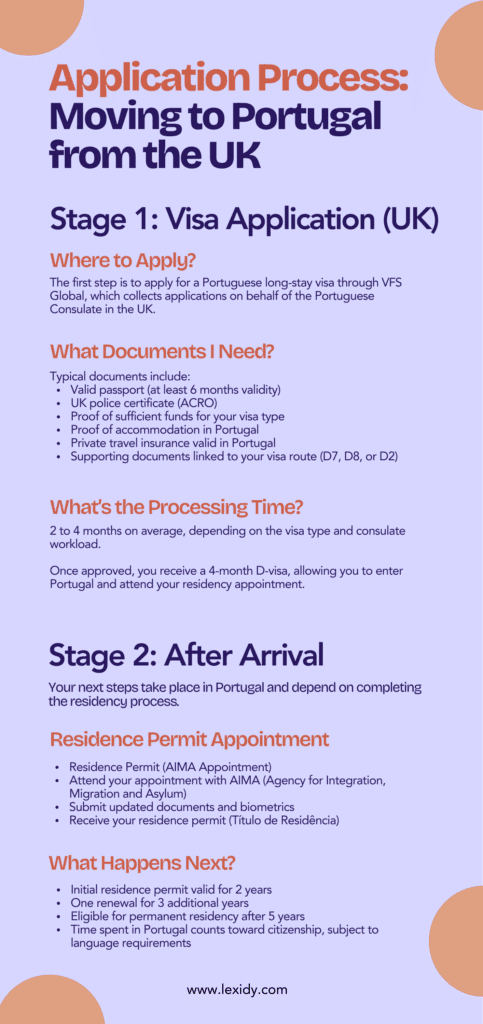
The D7 application follows a two-stage process. The first stage takes place at the Portuguese Consulate in the UK. The second stage occurs in Portugal after you arrive.
Stage 1: Apply at the Portuguese Consulate (London, Manchester or Edinburgh)
- Gather your documents: Passport, proof of income, bank statements, accommodation proof, recent criminal record certificate, travel insurance, NIF confirmation
- Book a consulate appointment: Slots at the Portuguese Consulate General in London fill quickly. Book as early as possible, ideally 8–12 weeks in advance
- Attend your appointment: Submit your application with the consulate fee (currently €90 for the D7 visa application)
- Await your D-type visa: Processing typically takes 60 business days. This visa is valid for 4 months and allows two entries into Portugal
- Travel to Portugal within the validity window of your D-type visa
Stage 2: Apply for Your Residence Permit with AIMA
- Arrive in Portugal: Within the validity period of your D-type visa
- Book an AIMA appointment to apply for your residence permit (Autorização de Residência). AIMA appointments for new residence permits are currently in high demand
- Attend your AIMA appointment with your full document set, including your D-type visa, passport, proof of address, and income evidence
- Pay the residence permit fee (currently €182.00 for the first permit)
- Receive your residence card: Processing takes around 3months. You will receive a receipt confirming your application is in progress, which serves as proof of legal residence in the interim
After 2 years, your first residence permit requires renewal. After 5 years of continuous legal residence, you become eligible for permanent residency and citizenship.
D7 vs Withdrawal Agreement: Key Differences
The D7 and the Withdrawal Agreement route lead to the same long-term destination, permanent residency and eventual citizenship eligibility, but the journey is very different. Understanding these differences is essential for anyone comparing dual residency UK and Portugal options or assessing which status applies to them.
| Factor | Withdrawal Agreement | D7 Visa |
| Who Qualifies? | Residents before 31 Dec 2020 | Anyone with passive income |
| Income Requirement | None | €920/month (2026) minimum |
| Language Test | Not required (WA exemption) | A2 for permanent residency/citizenship |
| Physical Presence | Flexible (up to 5 years absence after permanent residency) | 183+ days/year (tax residency required) |
| Right to Work | Yes, any activity | Yes, after the residence permit is issued |
| Path to Permanent Residency | Eligible after 5 years | 5 years of continuous legal residence |
| Path to Citizenship | 5 years (current rule) | 5 years (current rule) |
The physical presence requirement is the most significant practical difference for UK residents considering the D7. Unlike WA beneficiaries, D7 holders must spend at least 183 days per year in Portugal after being granted the Residence Permit to maintain residency status. Falling below this threshold does not automatically cancel your residence permit, but it can complicate renewals and your path to permanent residency. If you plan to split significant time between the UK and Portugal, take specialist immigration advice before applying.
For UK residents in Portugal after Brexit who arrived after December 2020 and have been living in Portugal without a formal permit, regularising your status through the D7 should be a priority. Remaining in Portugal without legal residency beyond the 90-day Schengen allowance carries serious consequences, including potential bans on re-entry and the impossibility of applying for any residence visa or permit for a significant period of time.
Frequently Asked Questions About Residency in Portugal for UK Citizens
Can UK citizens still live in Portugal after Brexit?
Yes. UK nationals who were resident before 31 December 2020 hold protected rights under the EU-UK Withdrawal Agreement. Those moving now need a visa. The D7 is the most common route for retirees and financially independent individuals.
How do I renew my Brexit residence card in Portugal?
Apply through AIMA’s new online portal at aima.gov.pt at least 2 months before your card expires. You will need your passport, current residence card, proof of address, proof of continued residence, and criminal record certificates from both Portugal and the UK.
Do I automatically get permanent residency after 5 years?
Yes. Under Article 15 of the Withdrawal Agreement, permanent residence is acquired automatically after 5 years of legal residence. You just need to submit a separate, short application. Your new AIMA card will confirm the status you already became eligible for by law.
Is Portuguese citizenship still available after 5 years?
Yes, under current rules. The 5-year eligibility threshold remains in effect following the Constitutional Court’s December 2025 ruling, which blocked key parts of a proposed reform that would have extended the requirement to 10 years. The law remains under parliamentary review.
What is the D7 visa and who is it for?
The D7 is a Portuguese residence visa for non-EU nationals with stable passive income. It suits retirees, pension recipients, and those living on rental income or dividends. From January 2026, applicants must demonstrate at least €920/month in passive income.
Do I need to speak Portuguese to renew my Brexit card?
No. Withdrawal Agreement beneficiaries are exempt from language requirements for both card renewal and permanent residency. A Portuguese language test is only required if you apply for citizenship, where you must demonstrate A2 proficiency through an approved CIPLE exam.
How long can I be outside Portugal without losing my residency?
It depends on your status. Temporary residence card holders risk losing their status after 6 months outside Portugal in a 12-month period. Permanent residence card holders can be absent for up to 5 consecutive years without losing their right to reside.
What happens if my AIMA application is delayed?
Your legal residence status is protected while your renewal is pending under Article 18(3) of the Withdrawal Agreement. Carry your expired card and your AIMA confirmation reference number together as proof of status. If your application has been pending for more than 6 months, contact your local AIMA service centre in writing.
Need Legal Help Applying for Residency in Portugal for UK Citizens?
2026 marks a turning point for residency in Portugal for UK citizens. Whether you are renewing an expiring Brexit card, confirming your permanent residence status, exploring citizenship before the law changes, or planning a move via the D7 visa, the decisions you make this year carry long-term consequences. The rules are detailed, AIMA processing times are slow, and the citizenship legislation remains in flux. Getting the process right from the start saves significant time and stress.
If you are unsure which pathway applies to you, or you want to make sure your renewal or application is handled correctly, Lexidy’s Portugal immigration team can help. From Brexit card transitions to Permanent Residence to D7 applications and citizenship eligibility assessments, our lawyers guide Brits living in or moving to Portugal every day.
Fill out the form below and one of our Portuguese immigration specialists will be in touch to clarify your options and help you move forward with confidence.