 Skip to content

Greek citizenship by residence is the most common path to Greek nationality for non-EU nationals who have legally lived in Greece for several years. It is a naturalization process based on long-term residence, integration into Greek society, and meeting specific legal requirements set by Greek authorities.
Unlike citizenship by descent, this route is not automatic. It requires time, preparation, and proof that life in Greece is stable and well established. For many long-term residents, however, it is the gateway to Greek and EU citizenship, offering long-term security and the right to live and work across the European Union.
This guide explains how Greek citizenship by residence works in 2026, who qualifies, how long the process takes, and what applicants should realistically expect before applying.
Table of Contents
- What Is Greek Citizenship by Residence?
- Greek Citizenship by Residence Requirements (2026)
- The Greek Citizenship Application Process
- Special Case: Greek Ancestry Outside Automatic Descent
- Common Challenges and Reasons for Delays
- Greek Citizenship vs. Other EU Countries
- FAQs: Greek Citizenship by Residence
- Is Greek Citizenship by Residence the Right Path for You?
What Is Greek Citizenship by Residence?

Greek citizenship by residence refers to acquiring Greek nationality through naturalization after living legally in Greece for a required period of time. It is suitable for non-EU nationals who have made Greece their long-term home and can demonstrate real ties to the country.
This pathway is different from citizenship by descent or investment-based residence. It is based on time, integration, and participation in Greek society, not ancestry or financial contribution alone.
How Naturalization in Greece Works
To qualify through residence, applicants must show that they are:
- Lawfully resident in Greece for the required number of years
- Integrated into Greek social and economic life
- Able to meet language, financial, and character requirements
- Greek authorities assess applications holistically. Length of stay matters, but so does how you spend your time in Greece.
Why This is The Standard Route
For most non-EU nationals without Greek ancestry, naturalization through long-term residence is the standard path to Greek citizenship. It leads to:
- Full Greek nationality
- EU citizenship rights
- Permanent security that is not tied to visas or permits
Because it is residence-based, this route is also the most regulated and often the slowest. Understanding the rules early helps avoid unrealistic expectations.
Curious if you qualify? Our trusted Greek immigration lawyers can help you understand the full requirements and ensure your application process is as smooth as possible.
Greek Citizenship by Residence Requirements (2026)
Greek citizenship by residence is granted through naturalization, which means meeting legal conditions that prove long-term, stable ties to Greece. The requirements help to confirm genuine integration, not just time on paper.
To apply for dual citizenship in Greece through naturalization, the law requires a minimum period of legal residency:
- Seven years of continuous legal residency in Greece for most applicants.
- Three-year residency for eligible fast-track categories:
- Spouses of Greek citizens
- Citizens of EU member states
- Parents of a minor child who is a Greek citizen
What “Continuous Legal Residence” Means
You must hold a valid residence permit throughout the qualifying period. Absences are okay, but should stay within the guidelines of up to 6 months per year or 10 months total over the full qualifying period.
Gaps in lawful residence can restart the counting period. Time in Greece before a residence permit is issued does not count.
Language Requirement
Applicants must successfully pass the Greek Language and Civic Knowledge Examination (Certificate of Adequate Knowledge for Naturalization)
The exam assesses:
- Greek language proficiency
- Knowledge of Greek history
- Knowledge of Greek geography
- Understanding of political institutions and culture
Financial Stability and Integration
Authorities assess practical integration, including:
- Stable and lawful professional activity
- Consistent tax compliance
- Social security contributions
Clean Criminal Record
A clean record matters, and serious issues can affect eligibility or outcome.
The Greek Citizenship Application Process
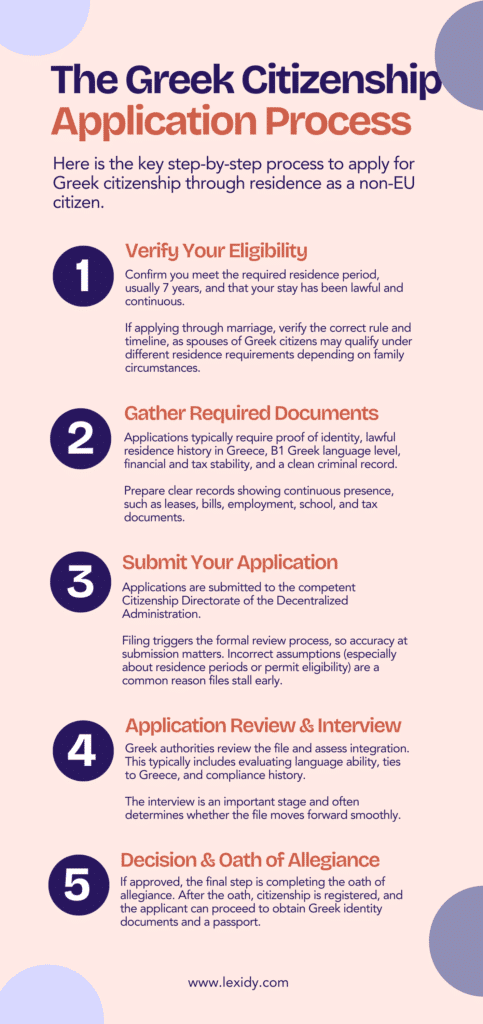
Greek citizenship by residence is a structured naturalization process. Each step matters, and missing documents or unclear residence history can slow things down significantly.
Step 1: Verify your eligibility
Confirm you meet the correct residence threshold (most commonly 7 years) and that your residence has been lawful and continuous. If your timeline is based on marriage, make sure you are applying under the correct rule, since spouses of Greek citizens may fall under different residence periods depending on family circumstances.
Step 2: Gather required documents
Documents vary by case, but applications typically require proof of:
- Identity and legal residence history in Greece
- Language qualification (usually B1 Greek)
- Tax and financial stability
- Clean criminal record
It helps to prepare a clear set of records showing continuous presence (leases, bills, employment, school records, and tax filings).
Step 3: Submit your application
Submit your application to the competent Citizenship Directorate of the Decentralized Administration. Filing triggers the formal review process, so accuracy at submission matters. Incorrect assumptions (especially about residence periods or permit eligibility) are a common reason files stall early.
Step 4: Application review and interview
Greek authorities review the file and assess integration. This typically includes evaluating language ability, ties to Greece, and compliance history. The interview is an important stage and often determines whether the file moves forward smoothly.
Step 5: Decision and oath of allegiance
If approved, the final step is completing the oath of allegiance. After the oath, citizenship is registered, and the applicant can proceed to obtain Greek identity documents and a passport.
Not sure where to begin? Speak with an experienced immigration lawyer in Greece to help understand your best path forward.
Special Case: Greek Ancestry Outside Automatic Descent
If you have Greek ancestry but do not qualify for citizenship by descent, residence-based naturalization may still be possible under specific conditions.
This applies when the family link is:
- More distant than a Greek parent, or
- Not sufficient to establish automatic nationality under Greek law
In these cases:
- A reduced residence period may apply in limited situations
- Ancestry must be clearly documented
- Language, integration, and financial stability requirements still apply
Greek ancestry alone does not guarantee faster citizenship. Authorities assess whether the family connection falls outside automatic nationality rules and whether you meet the integration requirements.
Common Challenges and Reasons for Delays

Greek citizenship by residence is a slow and document-heavy process. Most delays are procedural, not legal, and can often be anticipated.
Incomplete residence history
Gaps in permits, time spent in Greece before a residence permit was issued, or long absences abroad can interrupt the qualifying period and force authorities to reassess eligibility.
Language and integration issues
Failing the B1 Greek exam or performing poorly in the integration interview can stop an application from progressing, even if you meet the residence requirement.
Administrative backlogs
Applications are reviewed at multiple levels. Regional workload differences and manual processing mean files can sit inactive for long periods with no updates.
Incorrect assumptions
Applications are frequently delayed because applicants:
- Apply under the wrong residence rules
- Assume marriage or long residence guarantees approval
- Misunderstand which permits count
Why preparation matters
Most setbacks happen before submission. Clear documentation, correct eligibility assessment, and realistic expectations reduce the risk of years-long delays.
Greek Citizenship vs. Other EU Countries
Not sure whether Greece is the right naturalization route? Here’s a side-by-side snapshot of the most common benchmarks (residency, language, dual citizenship, and typical processing times).
| Country | Residency Requirement | Language Requirement | Dual Citizenship | Typical Processing Time |
| Greece | 7 years | B1 Greek | Allowed | 18–36 months |
| Spain | 10 years | A2 Spanish | Not Allowed | 12–24 months |
| Portugal | 10 years | A2 Portuguese | Allowed | 12–24 months |
| Italy | 10 years | B1 Italian | Allowed | 24–48 months |
| France | 5 years | B1 French | Allowed | 12–18 months |
What this comparison tells you
- Greece sits in the middle on residence time (longer than Portugal and France, shorter than Spain and Italy).
- Greece’s language bar is meaningful (B1), similar to Italy and France.
- Processing in Greece is often slow, so it helps to apply as soon as you are eligible and keep documentation tight while waiting.
FAQs: Greek Citizenship by Residence

How long do I need to live in Greece before applying?
Most applicants must complete 7 years of continuous legal residence before applying. Reduced periods apply only in specific cases, such as spouses of Greek citizens, and depend on family circumstances.
Is Greek citizenship by residence guaranteed after 7 years?
No. Meeting the residence requirement makes you eligible to apply, but approval is not automatic. Authorities assess language ability, integration, financial stability, and overall compliance.
Do I need to speak Greek?
Yes. Applicants must usually demonstrate Greek language proficiency at B1 level and pass an integration exam covering basic civic and cultural knowledge.
Can the time on all residence permits be counted?
No. Only qualifying residence permits count. Time spent in Greece before a permit is issued, on short-term visas, or with gaps in legal stay does not count.
How long does processing take after I apply?
Processing is slow. In practice, decisions often take 2 to 4 years after submission, depending on region and workload.
Can I apply from outside Greece?
No. You must submit your application for citizenship by residence while legally residing in Greece.
Is Greek Citizenship by Residence the Right Path for You?
Greek citizenship by residence is a long-term naturalization route for people who have built their lives in Greece. It is not automatic, and it requires more than simply spending time in the country. Language ability, financial stability, and genuine integration all matter.
For those who meet the requirements and are prepared for a lengthy process, naturalization can lead to full Greek and EU citizenship, with the right to live and work across the European Union. The key is entering the process with realistic expectations and a clear understanding of eligibility.
Not sure if you qualify or whether your residence history meets the legal criteria? A trusted Greek immigration lawyer can help you understand your options. Fill out the form below to get a clear eligibility assessment and understand the next steps before applying.