 Skip to content

Greek citizenship operates on a fundamentally different principle than many people expect. Unlike countries such as the United States or Canada that grant citizenship based on birthplace, Greece follows the jus sanguinis (right of blood) principle. This means citizenship is primarily acquired through Greek parentage rather than simply being born on Greek soil. As of 2026, children born to at least one Greek parent automatically acquire Greek citizenship at birth, regardless of where they are born.
However, Greece offers a pathway for children born in Greece to foreign parents under specific conditions, primarily requiring birth in Greece and completion of Greek schooling. Understanding Greek citizenship matters more than ever because it confers significant advantages: Greek citizenship means EU citizenship. As a Greek citizen, you gain the freedom to live, work, study, and retire in any of the 27 European Union member states, opening doors to opportunities across an entire continent.
Table of Contents
- Understanding Greek Citizenship by Birth
- Greek Citizenship by Birth Requirements in 2026
- The Greek Birth Certificate and Registration Process
- The Greek Citizenship Application Process
- Special Pathways to Greek Citizenship by Birth
- Common Challenges and How to Overcome Them
- Greek Citizenship by Birth vs Other EU Countries
- Frequently Asked Questions on Greek Citizenship by Birth
- Need Legal Support With Your Greek Citizenship by Birth Application?
Understanding Greek Citizenship by Birth

Greece’s approach to citizenship can seem complex at first, but it’s built on clear principles that have remained consistent for decades. To understand the process, you need to understand how Greece defines citizenship eligibility and what distinguishes it from other countries’ systems.
What is Jus Sanguinis (Right of Blood)?
Jus sanguinis is Latin for “right of blood”. It is a citizenship principle based on parentage rather than birthplace. Under this system, citizenship is transmitted from parent to child through the bloodline, regardless of where the child is born. Greece is one of many European countries that primarily uses this principle.
In practical terms, if you have at least one Greek parent, you are entitled to Greek citizenship whether you were born in Greece, the United States, Australia, or any other country. The location of your birth is irrelevant. What matters is your Greek ancestry. This principle also extends across generations, meaning you can pass Greek citizenship to your own children.
“Many people are surprised to learn they’re eligible for Greek citizenship through a grandparent or even a great-grandparent they never met. I’ve helped clients successfully claim citizenship going back four generations. Don’t assume you’re ineligible just because the connection seems distant.”
Eleftheria Charalambous, Head of Lexidy Greece Office
Does Greece Give Citizenship by Birth on Greek Soil?
Simply being born on Greek soil does not grant automatic citizenship if both parents are foreign nationals. This distinguishes Greece from countries that follow jus soli (right of soil), where birth within the country’s borders automatically confers citizenship.
However, Greece does provide a route to citizenship for children born in Greece to foreign parents. As of 2026, children born in Greece can acquire citizenship if they complete at least six years of Greek schooling. Additionally, one parent must have legally resided in Greece for at least five years before the citizenship application. This pathway recognizes that children who grow up and integrate into Greek society have meaningful ties to the country, even without Greek ancestry.
Benefits of Greek Citizenship
Greek citizenship offers advantages that extend far beyond Greece’s borders. As a Greek citizen, you automatically become a citizen of the European Union. This grants you the right to live, work, study, and establish businesses in any of the 27 EU member states without requiring visas or work permits.
Additionally, Greek citizens enjoy visa-free or visa-on-arrival access to over 180 countries worldwide, access to Greece’s public healthcare and education systems, the right to vote in Greek and European Parliament elections, and the ability to pass citizenship down to future generations. Greece also allows dual citizenship, so in most cases you don’t need to renounce your current nationality.
Greek Citizenship by Birth Requirements in 2026
The requirements for acquiring Greek citizenship by birth depend on your specific circumstances. The most important being whether you were born to at least one Greek parent or to foreign parents residing in Greece. Understanding which category applies to you is the first step in determining your eligibility and the process you’ll need to follow.
Citizenship for Children Born to Greek Parents
If at least one of your parents is a Greek citizen, you are entitled to Greek citizenship by birth through the jus sanguinis principle. The process is automatic, though registration is required. Examples of scenarios include:
- A child born to a Greek father (in or out of wedlock) receives automatic citizenship.
- A child born to a Greek mother (in or out of wedlock) also receives automatic citizenship. This right has been guaranteed since 1984, when Greece updated its nationality laws to ensure gender equality.
However, there are important conditions: at least one parent must be registered in a Greek municipality (dimotologio), and the parent’s Greek citizenship must have been acquired before the child’s birth. For children born abroad to Greek parents, registration with Greek consular authorities in the country of birth is required to formalize the citizenship and obtain documentation.
Citizenship for Children Born in Greece to Foreign Parents
Children born in Greece to foreign parents do not automatically acquire Greek citizenship at birth, but they can acquire it. The primary requirements are:
Parents must have legally resided in Greece for at least five years before the child’s birth. Alternatively, one parent must hold a long-term resident permit, second-generation permit, or permanent residence card. The child must also be enrolled in a Greek primary school and continue their studies in the Greek education system.
The application must be submitted by the parents while the child is still a minor. This pathway acknowledges that children who are born and raised in Greece, attending Greek schools and integrating into society, have substantial ties to the country.
Citizenship Through Greek School Attendance
Greece offers an education-based pathway for children who complete their schooling in Greece, even if they weren’t born there. To qualify via this pathway, you must:
Successfully complete nine years of primary and secondary education in Greece, OR complete six years of secondary education in a Greek school. If you completed your education as a minor, you must apply before age 21. If you completed it as an adult, you must apply within three years of completion.
Alternatively, graduating from a Greek university with prior Greek schooling also qualifies you for this pathway. This route is particularly relevant for children who moved to Greece at a young age and grew up within the Greek education system.
Summary: Greek Citizenship by Birth Requirements
| Category | Key Requirement | Notes |
| Born to Greek Parent(s) | At least one Greek parent registered in dimotologio | Automatic citizenship; parents’ citizenship must predate the child’s birth |
| Born in Greece to Foreign Parents | Parent(s) with 5+ years of legal residence OR a qualifying permit | Child must attend Greek school; application while a minor |
| Greek School Attendance | 6-9 years of Greek education | Apply before age 21 or within 3 years of completion |
| University Graduate | Greek university degree with prior Greek schooling | Must have attended Greek schools before university |
The Greek Birth Certificate and Registration Process

Whether your child is born in Greece or abroad, proper registration with Greek authorities is essential for establishing and documenting Greek citizenship. The Greek birth certificate serves as the primary proof of citizenship and is required for obtaining passports, identity cards, and accessing various services.
How to Obtain a Greek Birth Certificate
If your child is born in Greece, the hospital issues a medical birth certificate immediately after delivery. Within 10 days, parents must register the birth at the local Civil Registry Office in the municipality where the birth occurred. The office will then issue the official Greek birth certificate.
For children born abroad to Greek parents, register the birth at the nearest Greek consulate or embassy. You’ll need the foreign birth certificate (translated into Greek by a certified translator and apostilled) along with proof of the Greek parents’ citizenship. The consulate registers the birth and issues a Greek birth certificate, forwarding it to the Greek municipality where the Greek parent is registered.
Registering a Child’s Birth with Greek Authorities
Registration must be completed within specific timeframes. For births in Greece, you have 10 days from birth to register at the Civil Registry Office. Missing this deadline may result in fines. For births abroad, there’s no strict deadline, but register as soon as possible to minimize complications.
Both parents should ideally attend the registration appointment with all required documents, though one parent can proceed with authorization if necessary. Once registered, the child is entered into the Greek civil registry system and the parents’ municipal registry (dimotologio), establishing citizenship status.
Required Documents for Birth Registration
For births in Greece:
- Medical birth certificate from the hospital
- Valid identification (passports or ID cards) for both parents
- Parents’ marriage certificate (if applicable)
- Greek parents’ dimotologio certificate
- Completed birth registration forms
For births abroad:
- Foreign birth certificate (original with certified Greek translation and apostille)
- Valid passports for both parents
- Greek parents’ citizenship documents (passport, ID card, or citizenship certificate)
- Greek parents’ dimotologio certificate
- Parents’ marriage certificate with apostille and translation (if applicable)
- Consular registration forms
Processing times: 2-4 weeks in Greece; 4-8 weeks through consulates abroad.
The Greek Citizenship Application Process
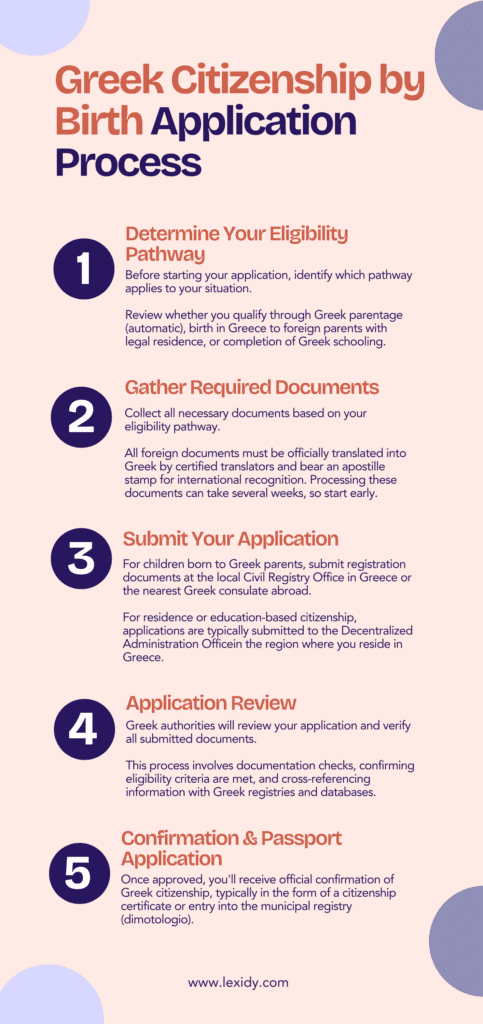
Applying for Greek citizenship by birth involves a structured process that varies depending on your eligibility pathway. While children born to Greek parents receive automatic citizenship upon registration, those qualifying through residence or education must formally apply. Understanding each step ensures a smooth application experience.
Step 1: Determine Your Eligibility Pathway
Before starting your application, identify which pathway applies to your situation. Review whether you qualify through Greek parentage (automatic), birth in Greece to foreign parents with legal residence, or completion of Greek schooling. Each pathway has different requirements and documentation needs.
Step 2: Gather Required Documents
Collect all necessary documents based on your eligibility pathway. Document requirements vary, but commonly include:
- Birth certificates (yours and your parents’ if claiming through descent)
- Parents’ marriage certificate (if applicable)
- Proof of Greek parents’ citizenship and dimotologio registration
- School attendance records and diplomas (for education-based applications)
- Proof of legal residence in Greece (for residence-based applications)
- Valid passport and identification documents
- Recent passport-sized photographs
All foreign documents must be officially translated into Greek by certified translators and bear an apostille stamp for international recognition. Processing these documents can take several weeks, so start early.
Step 3: Submit Your Application
For children born to Greek parents, submit registration documents at the local Civil Registry Office in Greece or the nearest Greek consulate abroad. For residence or education-based citizenship, applications are typically submitted to the Decentralized Administration Office in the region where you reside in Greece.
Submit original documents along with certified copies. Pay any required application fees (amounts vary by pathway and location). Obtain a receipt and reference number to track your application status. Some offices allow appointment scheduling online, while others operate on a walk-in basis.
Step 4: Application Review
Greek authorities will review your application and verify all submitted documents. This process involves documentation checks, confirming eligibility criteria are met, and cross-referencing information with Greek registries and databases.
Review timelines vary significantly:
- Automatic citizenship (Greek parentage): Immediate upon registration
- Residence/education-based applications: 6-18 months, depending on case complexity and backlog
You may be contacted for additional documentation or clarification, and some applicants may be required to attend an interview or provide supplementary evidence.
Step 5: Confirmation and Passport Application
Once approved, you’ll receive official confirmation of Greek citizenship, typically in the form of a citizenship certificate or entry into the municipal registry (dimotologio). With citizenship confirmed, you can immediately apply for Greek identity documents:
- Greek ID card: Apply at your local municipality
- Greek passport: Apply at passport offices or Greek consulates abroad
Passport processing takes approximately 2-4 weeks. As a Greek citizen, you’re also an EU citizen and can apply for residence registration in any EU country. Keep copies of all citizenship documents in a safe place, as they’ll be needed for future administrative processes.
Special Pathways to Greek Citizenship by Birth
Beyond the standard pathways, Greece recognizes several special circumstances that allow individuals to acquire citizenship by birth. These provisions address situations involving parental recognition, adoption, and historical changes to Greek nationality law.
Children Born Out of Wedlock
Children born outside of marriage have clear paths to Greek citizenship depending on which parent is Greek. A child born to a Greek mother receives automatic citizenship regardless of marital status. No additional requirements or recognition procedures are necessary.
However, a child born to a Greek father outside of marriage must have paternity officially recognized to acquire citizenship. This recognition can be completed in Greece or abroad through Greek consular authorities with proper documentation, including DNA testing if required. Once established, the child gains the same citizenship rights as children born within marriage.
Adopted Children
Greek law provides a straightforward path for adopted children to acquire citizenship. Children adopted by Greek citizens are automatically granted citizenship upon the finalization of the adoption, provided the adoption is legally recognized under Greek law.
This pathway applies only to children under 18 years of age at the time of adoption. The adoption must be completed through proper legal channels, and foreign adoptions must be validated by Greek courts to ensure they meet Greek legal standards before citizenship can be granted.
Historical Date Cutoffs
Greece’s citizenship laws have evolved, particularly regarding gender equality in transmitting citizenship. Understanding these historical changes is crucial for some applicants.
Before May 8, 1984, different rules applied for Greek mothers versus fathers. Greek mothers could not automatically transmit citizenship to their children born abroad, while Greek fathers could. Children born to Greek mothers before this date may need to follow special procedures or alternative pathways to claim citizenship.
Additionally, children born to Greek fathers in civil or non-Orthodox marriages before July 16, 1982, faced restrictions. These historical limitations have since been addressed through legal reforms. Individuals affected by these old rules may need to provide additional documentation or follow amended procedures to establish their citizenship claims.
Common Challenges and How to Overcome Them

While Greek citizenship by birth is straightforward in principle, applicants often encounter practical obstacles during the application process. Understanding these common challenges and knowing how to address them can save considerable time and frustration.
Missing or Incomplete Documentation
The most frequent obstacle is missing or incomplete documentation, which causes the majority of application delays. Common issues include the inability to locate old birth certificates, missing marriage certificates from parents or grandparents, missing apostille stamps on foreign documents, and improper translations.
How to overcome this: Start gathering documents 6-12 months before applying. Contact vital records offices in the countries where documents were issued. Work with certified translators experienced in Greek citizenship applications. If original documents are lost, Greek authorities may accept alternative evidence such as church baptismal records, school records, or sworn affidavits.
Name Discrepancies
Name variations across documents create complications, especially when Greek names are transliterated inconsistently (e.g., “Georgios” vs. “George”), women’s surnames change through marriage, or spelling variations exist across multiple documents.
How to overcome this: Provide a name reconciliation statement explaining variations and documenting changes chronologically. Include marriage certificates, divorce decrees, or legal name change documents. Use consistent name formatting across all new documents you submit.
Long Processing Times
Processing times vary widely by pathway and location. Automatic citizenship through Greek parents is processed in days to weeks, while residence or education-based applications can take 6-18 months or longer. Consular applications abroad often take longer than applications submitted within Greece.
How to overcome this: Submit complete applications with all required documents from the start. Incomplete applications automatically extend processing time. Follow up every 2-3 months for status updates. Consider working with a Greek attorney if your case is complex or time-sensitive.
Navigating these challenges alone can be overwhelming, particularly when dealing with time-sensitive situations or complex family histories. Our experienced Greek immigration team has helped hundreds of families successfully obtain Greek citizenship, handling everything from document authentication to liaising with Greek authorities on your behalf.
While official denial statistics aren’t publicly available, applications based on Greek parentage have very high approval rates (over 95%) when properly documented, as citizenship is a legal right. Education and residence-based applications have lower approval rates, with denials typically resulting from failure to meet residence or schooling requirements rather than discretionary rejections.
Greek Citizenship by Birth vs Other EU Countries
Understanding how Greece’s citizenship laws compare to those of other European Union countries can help you evaluate your options, especially if you have ancestry or connections to multiple EU nations. Each country has unique requirements and timelines that may better suit your circumstances.
| Country | Jus Sanguinis | Jus Soli | Dual Citizenship | Processing Time |
| Greece | Yes (primary) | Limited | Allowed | 6-24 months |
| Portugal | Yes | Yes (with conditions) | Allowed | 12-24 months |
| Italy | Yes | No | Allowed | 24-48 months |
| Spain | Yes | Limited | Limited | 12-24 months |
| France | Yes | Yes (born + resident) | Allowed | 12-18 months |
Greece’s jus sanguinis approach aligns with most EU countries, particularly Italy, which also grants citizenship primarily through descent. However, Greece offers more flexibility than Italy when it comes to children born on Greek soil, providing an education-based pathway that Italy lacks entirely.
Portugal and France are more generous with jus soli provisions, offering pathways for children born in-country to foreign parents with fewer restrictions. Spain’s approach is similar to Greece’s but imposes more limitations on dual citizenship, potentially requiring renunciation of other nationalities in certain cases.
Greece’s processing times fall in the middle range among EU countries. While faster than Italy’s notoriously lengthy process, it’s comparable to Spain and Portugal. The key advantage of Greek citizenship remains the immediate access to full EU benefits combined with the allowance of dual citizenship, making it particularly attractive for non-EU nationals seeking European mobility without sacrificing their original nationality.
Frequently Asked Questions on Greek Citizenship by Birth

Can my child born in Greece automatically get Greek citizenship?
Not automatically if both parents are foreign nationals. Your child can acquire Greek citizenship if one parent has legally resided in Greece for at least five years and the child attends a Greek school.
If at least one parent is a Greek citizen, then yes, your child automatically receives Greek citizenship regardless of birthplace.
Does Greece allow dual citizenship for children?
Yes, Greece allows dual and multiple citizenship without restrictions. Children who acquire Greek citizenship do not need to renounce any other nationality they hold.
How far back can I claim Greek citizenship by descent?
There is no generational limit, provided the citizenship chain remains unbroken. If your parent, grandparent, or great-grandparent was a Greek citizen and did not renounce their citizenship, you may be eligible. Each generation must have legally transmitted citizenship to the next.
What if my Greek parent never registered their citizenship?
Your Greek parent can register retroactively if they were entitled to citizenship. Once your parents’ citizenship is established in the Greek municipal registry (dimotologio), you can claim citizenship through them. This requires proving your parents’ eligibility through documentation.
Can I get Greek citizenship if only my grandparent was Greek?
Yes, but your parent must have acquired Greek citizenship first, even if never formalized. Citizenship must pass through each generation sequentially. Both you and your parent may need to register simultaneously if your parent never formalized their status.
How long does the Greek citizenship by birth process take?
Children born to Greek parents: 2-4 weeks in Greece or 4-8 weeks through consulates. Citizenship through residence or education pathways: 6-18 months, potentially extending to 24 months for complex cases. Processing times depend on office workload and documentation completeness.
Need Legal Support With Your Greek Citizenship by Birth Application?
Greek citizenship by birth offers a valuable pathway to European Union membership, whether through Greek parentage, birth in Greece, or Greek schooling. While the process requires careful documentation and attention to requirements, understanding your eligibility pathway puts you in a strong position to succeed.
The benefits are substantial: freedom to live and work across 27 EU countries, visa-free travel to over 180 nations, and the ability to pass citizenship to future generations. With Greece’s acceptance of dual citizenship, you can embrace these opportunities without sacrificing your current nationality.
Ready to start your Greek citizenship journey? The Greek immigration experts at Lexidy can help you identify your eligibility pathway, clarify necessary documentation, and assist in communicating with your nearest Greek consulate. Fill out the form below, and a member of the team will be in touch!