 Skip to content

The number of US citizens reclaiming Mexican nationality has grown significantly in recent years. Driven by cultural reconnection, expanded travel rights, property ownership in Mexico, and shifting US immigration policies, more people of Mexican heritage are taking the necessary steps to formalize their ties to Mexico. For many, it is not just a legal process. It is a personal one.
If you have at least one Mexican-born parent, you are likely eligible for Mexican citizenship by descent, regardless of your age or where you were born. The process is more accessible than most people expect, and the benefits extend well beyond a second passport.
At Lexidy, we are a team of immigration lawyers with an office in Mexico. We guide clients through the nationality process every day. This guide covers everything you need to know: who qualifies, which documents you need, how the process works step by step, and what mistakes to avoid along the way.
Table of Contents
- What is Mexican Citizenship by Descent?
- Who is Eligible for Mexican Citizenship by Descent?
- Required Documents for Mexican Citizenship by Descent
- How to Claim Mexican Citizenship by Descent: Step-by-Step
- Dual Citizenship: Mexico and the United States (and Other Countries)
- Benefits of Mexican Citizenship by Descent
- Common Mistakes and How to Avoid Them
- Frequently Asked Questions About Mexican Citizenship by Descent
- Ready to Claim Your Mexican Citizenship by Descent?
What is Mexican Citizenship by Descent?
Under the Mexican Constitution, any person born abroad to at least one Mexican-born parent is considered a Mexican national by birth. This is not naturalization. It is recognition of a right you already have. There is no age limit, no residency requirement, no Spanish language test, and no fee at most consulates. However, you must formally register your nationality to activate it.
The Constitutional Basis (Article 30)
Mexico’s Constitution recognizes two principles for nationality: jus soli (right of soil) and jus sanguinis (right of blood). Under Article 30, children born abroad to at least one Mexican national are classified as “Mexicanos por nacimiento.” This classification is one of the strongest forms of nationality recognition in Mexican law. It places Mexican citizenship through parents on equal legal footing with those born on Mexican soil.
Citizenship by Descent vs. Naturalization
Mexican citizenship by descent and naturalization are fundamentally different processes. Descent-based nationality is an automatic right. It requires no residency in Mexico, no Spanish proficiency exam, and no test on Mexican culture or history. Naturalization, by contrast, requires years of legal residency, demonstrated proficiency in Spanish, and a formal examination of Mexican history and values.
The key distinction matters: obtaining nationality by descent makes you a “national by birth,” not a naturalized citizen. This carries greater legal standing in certain contexts under Mexican law.
Can Grandchildren Claim Mexican Citizenship?
Citizenship in Mexico by descent applies to one generation at a time. Grandchildren of Mexican nationals do not qualify directly. However, there is a practical path forward. If the child of a Mexican national first registers their own Mexican nationality, their children can then claim through them.
The strategy is straightforward: the parent registers first, which opens the door for the grandchild to claim through a now-registered Mexican parent. This two-step approach is something our lawyers handle regularly for multi-generational families reconnecting with their Mexican heritage.
Who is Eligible for Mexican Citizenship by Descent?

You are eligible if at least one of your parents was born in Mexico and is therefore a Mexican national by birth. There is no age limit. Applicants range from newborns to adults in their 70s and 80s. You can claim even if your Mexican parent has passed away, is estranged, or was never married to your other parent. Marital status does not affect eligibility.
One Mexican-Born Parent Required
Either your mother or your father must be a Mexican national by birth. Only one parent needs to meet this requirement. The parent does not need to be alive, present, or actively involved in your application. What matters is that their Mexican nationality can be documented. This is the foundation of Mexican citizenship eligibility through parents and is the primary requirement under Article 30 of the Mexican Constitution.
No Age Limit
There is no deadline to claim birthright citizenship in Mexico. Adults in their 60s, 70s, and 80s apply successfully every year. Minors can also be registered, typically by a parent or legal guardian acting on their behalf. Note that documentary requirements differ slightly between applicants under 18 and those over 18. Children may need additional proof of parental authority, while adults apply directly in their own name.
Deceased, Estranged, or Absent Parent
Many applicants worry that a deceased or absent parent disqualifies them. It does not. If your Mexican parent has passed away, you will need to include their death certificate as part of your documentation. If your parent is estranged or uncooperative, you can still proceed using existing records. Their active participation is not required. What matters is that their Mexican nationality is verifiable through official documents.
Unmarried Parents
The marital status of your parents has no bearing on your eligibility. The one firm requirement is that your Mexican parent’s name appears on your birth certificate. If their name is present and their Mexican nationality can be documented, you qualify. Paternity or maternity disputes are separate legal matters and do not automatically block a nationality claim.
Required Documents for Mexican Citizenship by Descent
You will need your foreign birth certificate (apostilled and translated into Spanish), your Mexican parents’ Mexican birth certificates, your parents’ valid Mexican ID (passport, INE, or consular ID), your own valid photo ID, proof of address, passport-sized photos, and two adult witnesses who can attest to your identity. If your parent is deceased, their death certificate is required. All foreign documents must be apostilled and translated by a certified translator.
Applicant’s Documents
These are the core documents you must provide as the applicant:
| Document | Requirement |
| Foreign birth certificate | Apostilled + certified Spanish translation |
| Valid photo ID | Passport or driver’s licence |
| Proof of address | Utility bill, lease, or bank statement |
| Passport-sized photos | 2 to 4 photos (check consulate-specific requirements) |
Ensure that your name appears identically across all documents. Even minor spelling differences between your birth certificate and your ID can cause delays at the consulate.
Mexican Parent’s Documents
Your parents’ documentation establishes the legal link that makes your claim valid under Mexican citizenship through your parents. You will need:
| Document | Notes |
| Mexican birth certificate (acta de nacimiento) | A recent certified copy is required |
| Valid Mexican ID | Passport, INE (voter ID), or consular matrícula |
| Marriage certificate | Required if applicable to your family situation |
| Death certificate | Required if your Mexican parent is deceased |
Request a recent certified copy of the acta de nacimiento directly from the Mexican Civil Registry. Older copies are sometimes rejected. If your parent has an expired passport or an outdated INE, contact the consulate in advance to confirm what substitutes are accepted.
Apostilles and Translations
All documents issued outside Mexico must carry a Hague Apostille before they are accepted by Mexican authorities. This applies to your birth certificate and any other foreign-issued documents in your file. Once apostilled, each document must be translated into Spanish by a certified sworn translator, known in Mexico as a perito traductor. Standard translations from non-certified sources are not accepted.
Name consistency is critical. Your name must appear exactly the same across all documents in your application. A middle name that is missing in one document but present in another is sufficient to trigger a request for additional evidence.
Witnesses
Two adult witnesses are required at your consulate appointment. Both must be at least 18 years old and present valid photo identification on the day. Their role is to formally attest to your identity and your relationship to your Mexican parent. They do not need to be family members. However, they should be people who can speak to who you are if asked. Consulate staff may ask them brief questions during the appointment.
Special Cases: Minors Under 18
Applications for minors follow a stricter process. Both parents or legal guardians must be present at the appointment. If one parent cannot attend, a notarized consent document is required. Some consulates also require a pediatrician’s letter and a photograph of the child for applicants under 7 years old. Requirements can vary by consulate, so confirm the specific list with your local Mexican consulate before the appointment.
How to Claim Mexican Citizenship by Descent: Step-by-Step
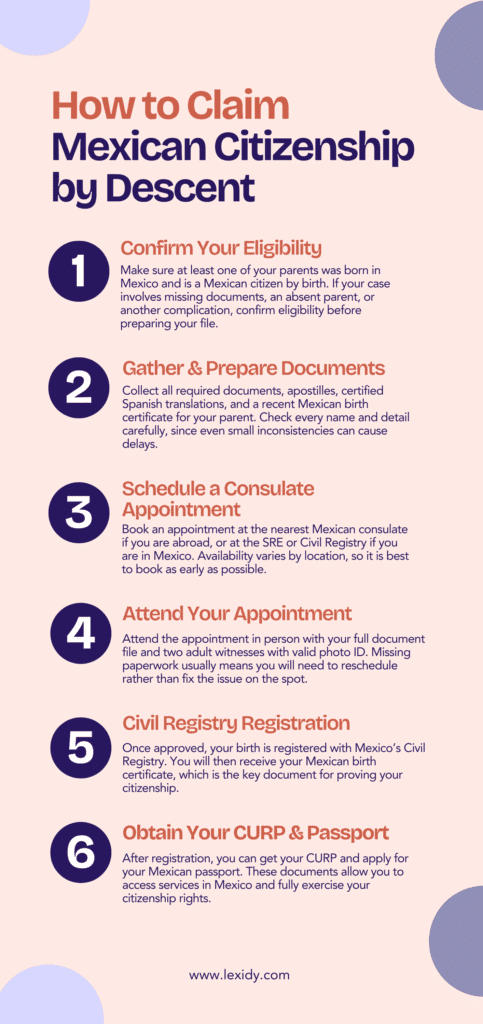
The process involves six stages: confirming eligibility, gathering and preparing documents, scheduling a consulate appointment, attending in person with witnesses, registering with the Civil Registry, and obtaining your CURP and Mexican passport. The entire process typically takes 2 to 6 weeks at most consulates, and there is no registration fee in most cases.
Step 1: Confirm Your Eligibility
Before gathering any documents, confirm that at least one of your parents was born in Mexico and holds Mexican nationality by birth. Review the eligibility criteria in the section above. If you are unsure whether your parent qualifies, or if your family situation is complex (deceased parent, absent parent, unmarried parents), this is the right moment to seek legal guidance before investing time in document preparation.
Step 2: Gather and Prepare Documents
This step takes the most time. Obtain an apostille for every foreign-issued document in your file. Request a recent certified copy of your parents’ Mexican birth certificates directly from the Civil Registry in Mexico. Commission certified Spanish translations from a perito traductor for all non-Spanish documents. Check name consistency across every document before your appointment. A mismatch as small as a missing middle name can delay your registration by several weeks.
Step 3: Schedule a Consulate Appointment
If you are based outside Mexico, apply at the nearest Mexican consulate. The United States alone has more than 50 Mexican consulates, making access relatively straightforward for most applicants pursuing Mexican citizenship from the US. If you are already in Mexico, you can apply directly at an SRE (Secretaría de Relaciones Exteriores) office or your local Civil Registry. Appointment availability varies by location. Book as early as possible, particularly at high-demand consulates in cities like Los Angeles, Chicago, and New York.
Step 4: Attend Your Appointment
Attendance in person is mandatory. Bring your two adult witnesses with valid photo ID. If your Mexican parent is alive and able to attend, their presence strengthens the application. If they cannot attend, a notarized power of attorney can substitute in many cases. Arrive with a complete, organized document file. Consulate staff will review everything on the day. Missing documents typically mean a new appointment rather than a same-day resolution.
Step 5: Civil Registry Registration
Once your appointment is approved, the consulate registers your birth with Mexico’s Civil Registry. You are formally recorded as a “Mexicano por nacimiento.” Following this registration, you receive a Mexican birth certificate, your acta de nacimiento. This document is the legal foundation for everything that follows, including your passport application and access to the rights that come with birthright citizenship in Mexico.
Step 6: Obtain Your CURP and Mexican Passport
After registration, you will receive your CURP (Clave Única de Registro de Población), Mexico’s unique population identification number. Your CURP is required to access government services, open a bank account, and apply for a Mexican passport. The passport application fee is approximately $3,205 MXN (around $188 USD) for a 10-year adult passport. Processing times vary but typically run 10 to 15 business days once the application is submitted.
Dual Citizenship: Mexico and the United States (and Other Countries)
Mexico has permitted dual nationality since 1998. Acquiring Mexican citizenship by descent does not affect your US citizenship. The US also allows dual citizenship. You can hold both passports simultaneously and use each for different purposes. For example, you can use your Mexican passport for visa-free travel within the EU and your US passport for re-entry into the United States.
Mexico’s 1998 Dual Nationality Law
Before 1998, Mexicans who acquired a foreign nationality automatically lost their Mexican citizenship. A constitutional reform that year changed this permanently. Mexico now recognises dual nationality without restriction. There is no requirement to renounce your existing citizenship when registering for birthright citizenship in Mexico.
This applies regardless of which country your second nationality comes from. Canadians, British nationals, and citizens of other countries can claim Mexican citizenship under the same framework.
Impact on US Citizenship
US law does not prohibit dual citizenship. Acquiring Mexican nationality through descent carries no legal risk to your US citizenship. You will not be asked to renounce your US passport, and no formal notification to US authorities is required.
This is a point of concern for many first-generation Americans exploring how to get double nationality in Mexico, and the answer is consistent: both governments permit it, and neither penalises you for holding both nationalities.
We see a lot of clients hesitate because they fear losing their US status. The reality is that obtaining Mexican citizenship through descent is entirely compatible with maintaining full US citizenship. The two nationalities coexist without conflict, and clients often wish they had started the process sooner.”
Francisco Tolentino, Immigration Lawyer
Obligations of Dual Citizens
Holding two nationalities comes with responsibilities in both countries. When in Mexico, you are subject to Mexican law. When in the United States, US law applies. Two areas require particular attention.
| Obligation | Detail |
| Tax obligations | The US taxes citizens on worldwide income. Cross-border tax implications should be reviewed with a qualified advisor. |
| Military service | Both Mexico and the US have provisions for military service. Obligations vary based on age, residency, and individual circumstances. |
| Legal compliance | You must comply with the laws of whichever country you are physically present in at any given time. |
Tax implications are the area most likely to affect everyday life, particularly for those who split time between both countries or earn income in Mexico. Consulting a cross-border tax advisor before and after registering your Mexican nationality is a practical step worth taking.
Benefits of Mexican Citizenship by Descent

Mexican citizenship by descent unlocks a range of practical and personal advantages. Key benefits include visa-free or visa-on-arrival access to 150+ countries (including the EU Schengen area), the right to live and work in Mexico without permits, the ability to own property anywhere in Mexico, including restricted coastal and border zones, access to Mexican public services, voting rights, cultural reconnection, and a meaningful safety net for geopolitical uncertainty.
Travel Benefits (150+ Countries Visa-Free)
A Mexican passport currently provides visa-free or visa-on-arrival access to more than 150 countries. This includes the full EU Schengen area, the United Kingdom, Japan, and South Korea. For US citizens, this is a useful complement rather than a replacement. There are destinations where the Mexican passport offers a smoother entry process or removes the need for advance visa applications. Holding both documents gives you the flexibility neither passport provides on its own.
Right to Live and Work in Mexico
As a registered Mexican national, you have the full right to live and work in Mexico without applying for a visa, residency permit, or work authorization. This is a significant advantage over foreign nationals who must navigate Mexico’s immigration system before building a life there. For those considering a relocation or extended stay, this right removes one of the most common logistical barriers. Our Mexico Relocation service helps clients transition smoothly once their nationality is confirmed.
Property Ownership in Restricted Zones
Mexican law restricts foreign nationals from owning property within 50 kilometers of the coastline or 100 kilometers of international borders without using a bank trust known as a fideicomiso. This structure adds cost and complexity to property purchases in some of Mexico’s most desirable areas, including Los Cabos, Cancun, Puerto Vallarta, and Tulum. Mexican citizens face no such restriction.
They can purchase property directly in these zones, with full title in their own name. For those with Mexican heritage considering property investment, this benefit alone can justify the process of registering their nationality.
Cultural Connection and Heritage
Registering your Mexican citizenship through your parents is also an act of cultural reclamation. As a Mexican national, you gain the right to vote in Mexican federal elections, participate in government cultural programs, and formally belong to the country your family comes from. For many applicants, particularly first-generation Americans, the process of reconnecting with their Mexican heritage carries personal significance that goes well beyond the legal and practical benefits.
Many of our clients tell us that claiming their Mexican nationality felt like completing something that had always been unfinished. Beyond the passport and the property rights, there is a sense of identity restored. That is often what motivates people to start the process in the first place.
Francisco Tolentino, Immigration Lawyer
Safety Net and Geopolitical Flexibility
The right to relocate to Mexico at any time, without visa applications or immigration hurdles, is an increasingly valued benefit. Interest in Mexican dual nationality has grown noticeably in recent years, with many US-based applicants citing shifting immigration policies and political uncertainty as motivating factors. Having a second nationality does not require you to use it.
However, knowing that the option exists provides a level of security that is difficult to quantify. Mexico offers a familiar cultural environment, a lower cost of living than most US cities, and full legal rights for those who hold its nationality.
Common Mistakes and How to Avoid Them
The Mexican citizenship by descent process is straightforward when documents are prepared correctly. Most delays and rejections stem from a small number of avoidable errors. Knowing what they are before you start saves significant time and frustration.
Inconsistent Names Across Documents
Name mismatches are the single most common cause of delays when applying for Mexican citizenship. A middle name present on your birth certificate but absent from your ID, a hyphenated surname rendered differently across documents, or a translation that alters the spelling of a name are all enough to trigger a request for additional evidence.
Before your appointment, lay every document side by side and verify that your full legal name appears identically across all of them. If a discrepancy exists, address it before the appointment, not on the day.
Missing or Expired Apostilles
An apostille certifies the authenticity of a document for international use under the Hague Convention. Every foreign-issued document in your application requires one. A common mistake is submitting documents with outdated apostilles or assuming that a notarised copy is sufficient.
Apostilles do not technically expire, but some consulates require documents to be apostilled within a specific timeframe. Confirm the requirements with your consulate before submission. If your documents were apostilled several years ago, it is worth verifying whether a fresh apostille is expected.
Incorrect Translation Format
Certified Spanish translations must be completed by a perito traductor, a sworn translator formally recognized by Mexican authorities. Translations produced by general translation agencies, online services, or bilingual individuals are not accepted. This is a firm requirement, not a preference.
If you are preparing documents in the United States, ensure your translator is specifically recognized for Mexican legal purposes. A translation rejected on format grounds means starting that step again from scratch.
Assuming Grandchildren Automatically Qualify
Mexican citizenship through parents applies to one generation at a time. A grandchild of a Mexican national does not qualify directly for birthright citizenship in Mexico unless their parent has already registered their own Mexican nationality. This is one of the most frequently misunderstood aspects of the process.
If you are helping a grandchild claim Mexican nationality, the first step is registering the intermediate parent. Only once that parent holds a recognized Mexican nationality can the grandchild apply through them. Our Mexico Immigration service regularly assists families navigating this two-step process.
Not Bringing Witnesses
Two adult witnesses are required at most consulate appointments. Both must carry a valid photo identification on the day. Arriving without witnesses or with witnesses who lack acceptable ID typically results in a canceled appointment and a new booking date. Confirm witness requirements with your specific consulate in advance, as some locations have additional conditions regarding who qualifies. Brief your witnesses on what to expect so there are no surprises on the day.
Frequently Asked Questions About Mexican Citizenship by Descent

Can I get Mexican citizenship by descent if my parent was born in Mexico?
Yes. If at least one of your parents was born in Mexico and holds Mexican nationality by birth, you qualify for Mexican citizenship through your parents, regardless of your age or country of birth.
Can grandchildren claim Mexican citizenship by descent?
Not directly. Grandchildren must first register the intermediate parent’s Mexican nationality. Once that parent is registered, the grandchild can apply through them.
How long does it take to get Mexican citizenship by descent?
The process typically takes 2 to 6 weeks from the time of your consulate appointment. Document preparation, including apostilles and certified translations, often takes longer than the appointment itself.
Is there a fee for Mexican citizenship by descent?
Most Mexican consulates charge no fee for the nationality registration itself. Once registered, obtaining a Mexican passport costs approximately $3,205 MXN (around $188 USD) for a 10-year adult passport.
Can I get Mexican citizenship by descent if my Mexican parent is deceased?
Yes. A deceased parent does not disqualify you. You will need to include their Mexican birth certificate and death certificate in your application as supporting documentation.
Does getting Mexican citizenship affect my US citizenship?
No. The US permits dual citizenship, and acquiring citizenship in Mexico by descent carries no risk to your US nationality. You can hold both passports simultaneously without issue.
Do I need to speak Spanish to claim Mexican citizenship?
No. Birthright citizenship in Mexico by descent requires no Spanish-language test or proficiency exam. This clearly distinguishes it from the naturalization route, which includes a language requirement.
Where do I apply for Mexican citizenship by descent?
If you are based outside Mexico, apply at your nearest Mexican consulate. The US has more than 50 consulate locations. If you are already in Mexico, apply at an SRE office or your local Civil Registry.
What documents do I need for Mexican citizenship through my parents?
Core documents include your apostilled foreign birth certificate with certified Spanish translation, your Mexican parents’ acta de nacimiento, a valid Mexican ID for your parent, your own photo ID, proof of address, passport photos, and two adult witnesses. Full details are covered in the documents section above.
Can I own property in Mexico once I have citizenship?
Yes. As a Mexican national, you can purchase property anywhere in Mexico, including restricted coastal and border zones, without the need for a fideicomiso bank trust. This is one of the most significant practical benefits of getting double nationality in Mexico.
Ready to Claim Your Mexican Citizenship by Descent?
Citizenship by descent in Mexico is one of the most accessible nationality processes available to people of Mexican heritage. If you have at least one Mexican-born parent, the right already belongs to you. The process requires preparation, attention to document detail, and an in-person consulate appointment. With the right guidance, most applicants complete it without significant complications.
Whether your motivation is travel flexibility, property rights, cultural reconnection, or simply securing a second nationality for your family, the path forward is clearer than most people expect. Our immigration lawyers work with clients at every stage of the process, from confirming eligibility to obtaining the final passport.
If you are ready to claim your Mexican nationality. Fill out the form below, and a member of our team will be in touch to guide you through the next steps.