 Skip to content

Spain permanent residence is a key milestone for non-EU nationals looking to secure long-term stability. Officially known as the Tarjeta de Larga Duración, this status allows holders to live and work indefinitely after five years of legal and continuous residency. It’s often the next step for those ready to put down permanent roots.
Many people confuse permanent residency with the physical card. The card renews every five years, but the status itself does not expire. Once granted, it offers long-term stability, freedom to work under almost any employment category, and rights that closely resemble those of Spanish nationals.
This guide breaks down how the five-year rule works, the absence limits you must follow, and which visas count toward long-term residency. It gives you a clear roadmap to help you move from temporary residency to a permanent, secure life in Spain.
(Article Updated December 2025)
Table of Contents
- Spain Permanent Residence vs. Long-Term Residence: What’s the Difference?
- Spain Permanent Residence Checklist: How Long Can You Stay Abroad?
- Calculating the 5-Year Continuous Residence Period
- Are There Exceptions to Spain’s Permanent Residence Rules?
- Spain Permanent Residence Application Process
- Frequently Asked Questions about Spain Permanent Residence
- Is Spain Permanent Residence the Right Next Step for You?
Spain Permanent Residence vs. Long-Term Residence: What’s the Difference?
Spain uses the term “permanent residency” informally, but legally, there are two different statuses depending on who you are.
For family members of EU nationals
If you are a non-EU family member of an EU citizen, Spain grants what is legally considered permanent residence under EU free-movement rules.
- Available after 5 years of continuous residence in Spain
- Governed by EU law, not general immigration law
- Loss and recovery rules are more flexible
- Stronger protection against losing status due to absences
This is the only situation where the term “permanent residence” exists as such in Spanish law.
For all other non-EU nationals
For non-EU nationals who are not family members of an EU citizen, Spain does not grant “permanent residency” by name.
Instead, the correct legal status is Long-Term Residence (Residencia de Larga Duración).
Although it offers similar rights, it is a different legal figure with its own rules.
- Available after 5 years of legal and continuous residence
- Governed by Spanish immigration law
- Absence limits apply when qualifying
- Easier to lose if you live outside Spain for extended periods
- Separate rules apply for recovery if it is lost
Why the distinction matters
Even though both statuses allow you to live and work in Spain indefinitely, the legal basis, requirements, and loss rules are not the same.
Understanding which status applies helps avoid mistakes when planning absences, renewals, or long-term settlement goals.
Spain Permanent Residence Checklist: How Long Can You Stay Abroad?
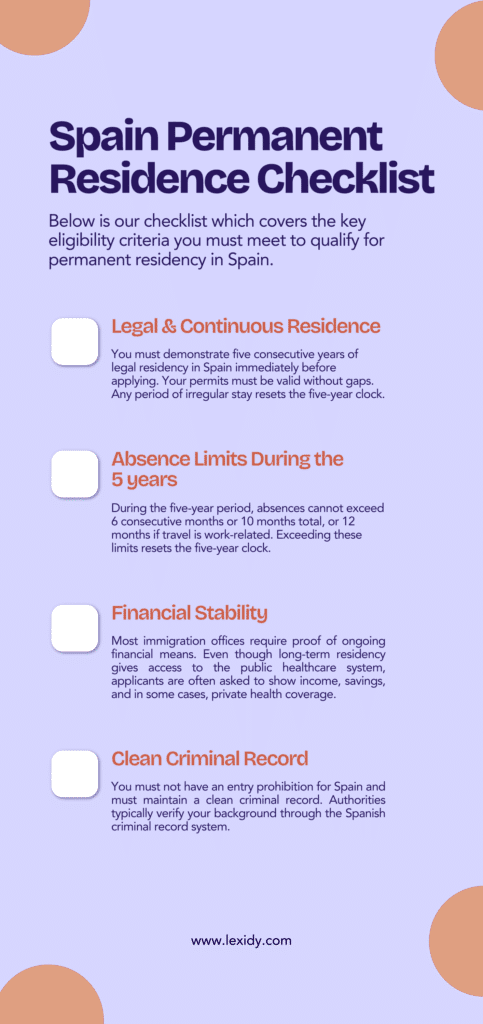
To qualify for Spain permanent residence, you must meet several legal and residency requirements. Understanding the exact Spain permanent residence requirements is essential, especially when calculating time spent outside the country.
Absence limits are one of the most common reasons long-term residency applications are delayed or denied, so they need to be followed carefully. Below is a clear checklist to help you assess whether you meet the criteria.
1. Legal and Continuous Residence
You must demonstrate five consecutive years of legal residency in Spain immediately before applying. Your permits must be valid without gaps. Any period of irregular stay resets the five-year clock.
2. Absence Limits During the Five Years
Spain applies strict rules regarding time spent outside the country. These limits directly determine whether your residency period is considered “continuous.”
- You cannot be outside Spain for more than 6 consecutive months at any point during the five-year period.
- Your combined time outside Spain cannot exceed 10 months total across the five years.
- If absences are for work-related reasons, the total allowance increases to 12 months.
- Exceeding any of these limits means the five-year calculation restarts.
3. Financial Stability
Most immigration offices require proof of ongoing financial means. Even though long-term residency gives access to the public healthcare system, applicants are often asked to show income, savings, and in some cases, private health coverage.
4. Clean Criminal Record
You must not have an entry prohibition for Spain and must maintain a clean criminal record. Authorities typically verify your background through the Spanish criminal record system.
Important: Many local benefits, such as tax incentives, public transport discounts, and resident flight reductions in the islands, require official residence registration and actual presence in Spain.
Calculating the 5-Year Continuous Residence Period
Understanding how Spain calculates the five-year requirement is one of the most common points of confusion for anyone applying for Spain permanent residence. Each residence permit contributes differently.
Below is a clear breakdown of what counts and what doesn’t.
Residence Permits That Count in Full (1 Year = 1 Year)
| Permit Type | Counts Toward Spain Permanent Residence? | How It Counts | Notes |
| Non-Lucrative Visa (NLV) | Yes | Full year = 1 year | Must be continuous and legally maintained. |
| Highly Qualified Worker (PAC) | Yes | Full year = 1 year | Includes skilled professional categories. |
| Work Permit – Employee | Yes | Full year = 1 year | Standard employed residency. |
| Work Permit – Self-Employed | Yes | Full year = 1 year | Applies to autónomo permits. |
| Digital Nomad Visa (DNV) | Yes | Full year = 1 year | Confirmed across immigration offices. |
| Golden Visa (now discontinued) | Yes | Full year = 1 year | Only for existing holders. No new applicants. |
Note: Although Spain’s Golden Visa program has been discontinued, any years previously held still count in full toward permanent residency for existing permit holders. New applicants, however, can no longer access this route.
Residence Permits That Count at Half Value (1 Year = 0.5 Years)
| Permit Type | Counts Toward Spain Permanent Residence? | How It Counts | Notes |
| Student Visa | Partially | 1 year = 0.5 years | 4 years of study = 2 years of qualifying residency. |
Only one category counts at half value, which is the Student Visa.
Each year under a student residence counts as six months toward permanent residency. For example, 4 years as a student equals 2 years of qualifying residence.
Because of this reduced weighting, former students often need additional years under a full-count permit before they reach eligibility.
Residence Stays That Do Not Count
| Permit Type | Counts Toward Spain Permanent Residence? | Reason |
| Tourist/Short-Stay Visa | No | Not considered legal residency. |
| Irregular Stay | No | Breaks continuity and resets the clock. |
| Gaps Between Permits | No | Only protected if under an active renewal. |
| Short-Term Study (<180 days) | No | Not treated as resident-level stay. |
Why Accurately Calculating Your Years Matters
If your history includes a mix of student years, work permits, or time on newer categories like the Digital Nomad Visa, your permanent residency eligibility may not align with your calendar years in Spain. Calculating this correctly helps avoid unnecessary rejections or delays.
Need help confirming your eligibility? If you want support calculating your timeline or reviewing which permits count toward your five-year period, fill out the form below to speak with a lawyer.
Are There Exceptions to Spain’s Permanent Residence Rules?

The general rules for Spain permanent residence apply to most non-EU citizens. Still, there are a few exceptions that allow for longer absences from Spain during the five-year qualifying period. These exceptions are narrow, carefully defined, and only apply in very specific circumstances.
Those working for organizations that act in the public interest
Some applicants are permitted to spend more than six months per year outside Spain if they work for:
- International development organizations
- Research institutions
- NGOs involved in humanitarian aid
- Foundations or associations recognized for public-interest work
These entities must be officially registered and accredited. Eligible applicants can maintain their five-year continuous residence even when their professional duties require long periods abroad.
This exception is especially relevant for people involved in:
- Overseas humanitarian missions
- Research projects outside Spain
- International cooperation assignments
Spain Permanent Residence Application Process

Once you meet the Spain permanent residence requirements, the next step is submitting your application for the Tarjeta de Larga Duración. The process is straightforward, but timing, documentation, and accuracy are essential to avoid delays.
Below is a simple, step-by-step guide to help you understand how the application works from start to finish.
1. Check When You Are Allowed to Apply
Applications must be filed with the Oficina de Extranjería:
- The date you meet the 5-year residence requirement, independent of the expiration date of the permit held at that point.
- If the permit expires right on the day you meet the 5-year requirement, 30 days in advance is the maximum a request has been accepted
Applying within this window ensures your legal stay is protected while your case is being reviewed.
Step 2: Complete Form EX-11
Form EX-11 is the official application for long-term residency in Spain.
This form is required for all applicants and must be completed accurately to avoid administrative delays.
Step 3: Gather the Required Documentation
The documents you need will depend on which long-term status applies to your situation.
- EU permanent residence for non-EU family members of EU citizens
- Long-term residence for all other non-EU nationals under Spanish immigration law
Each status follows different legal rules and requires slightly different documentation. Getting this right from the start helps avoid delays or refusals.
An experienced immigration lawyer can guide you through the process and make sure everything is prepared correctly. Fill out the form below to get a free consultation!
Step 4: Submit Your Application
You can submit through:
- In-person appointment at your local Oficina de Extranjería
- Online submission through a legal representative or authorized portal
Procedures vary by province, so local instructions should be confirmed.
Step 5: Wait for the Resolution
The immigration office has up to 3 months to issue a decision.
Important details:
- If approved, you can move forward with biometrics.
- If no response is issued within 3 months, it legally counts as negative administrative silence (rejection).
In practice, delays beyond 3 months are common, and many cases receive decisions after the legal deadline.
Step 6: Provide Biometrics and Collect Your Long-Term TIE
Once your application is approved:
- Book a police appointment for fingerprints.
- Submit biometric data and photographs.
- Collect your new TIE card, valid for five years.
The card must be renewed every five years, but the long-term residency status itself does not expire.
Frequently Asked Questions about Spain Permanent Residence

1. How do I calculate time away for my Spanish Permanent Residency?
For long-term or permanent residency cards in Spain, time away is counted from the moment you leave the European Union until you return via the entry and exit stamps on your passport.
For temporary residency cards, which typically allow a six-month absence, simply count the days you’ve been abroad in the past year from the current date, ensuring it doesn’t exceed six months.
2. Can I recover my residency card that has expired due to excessive time abroad?
If you’ve been outside Spain for too long and your residency card has expired, here’s what you need to know.
Long-Term Residency Card Recovery:
- Applies to 5 or 10-year cards.
- If you’ve been away for more than one year, you can recover your card.
- Apply for a specific visa at the Spanish consulate in your current country.
- The consulate will liaise with Spanish immigration to check your background.
- If cleared, you’ll get a visa to enter Spain, re-register fingerprints, and recover your card.
- In some cases, you can request recovery after entering Spain, but it’s rare.
Temporary Residency Card Recovery:
- If you have a temporary residency card and leave Spain for too long without renewal, the card is permanently lost.
- To return to Spain, you’ll have to start the visa or residence permit process from scratch.
- The exception is for those who voluntarily returned to their home country and have a job offer in Spain.
To avoid these complications, it’s best to adhere to the time limits discussed earlier.
3. What if I am a family member of an EU citizen? Do these rules apply to me?
Family members of EU citizens fall under a different legal regime than other non-EU nationals.
The initial residence card issued to family members of EU citizens is valid for five years and is governed by EU free-movement rules, not Spanish immigration law.
During this initial five-year period:
- Absences are more flexible than under standard Spanish residence permits
- The residence right can be lost if you live outside Spain for two consecutive years
- Shorter or non-consecutive absences are generally allowed and do not affect renewal
After completing five years of residence, you can apply for a permanent residence card under the EU Community regime, which is valid for 10 years.
With this permanent residence card:
- You can be absent from Spain for up to two consecutive years without losing your status
Because this regime follows different rules and loss criteria, it is important not to apply the standard long-term residence absence limits to EU family members.
Is Spain Permanent Residence the Right Next Step for You?
Achieving Spain permanent residence is an important step if you plan to stay in the country long term. Once you understand the five-year rule, absence limits, and how your past permits count, the process becomes much more straightforward.
Permanent residency provides long-term stability, the ability to work freely, and a status that does not expire. If Spain is where you see your future, this is the milestone that secures it.
If you want help confirming your eligibility, fill out the form below to speak with a lawyer.