 Skip to content

Dual citizenship in Mexico is fully legal and widely recognized, making it an attractive option for people who want to keep their current nationality while gaining the rights and protections of Mexican citizenship. Whether the connection comes through family ties, long-term residence, or marriage, Mexico offers clear legal pathways to hold two passports at the same time.
For many Americans and Canadians, the appeal goes beyond paperwork. Mexican dual citizenship can provide the right to live and work in Mexico without restrictions, easier access to property ownership, and long-term security in a country with strong cultural and economic ties to North America.
This guide explains how dual citizenship in Mexico works in 2026, who qualifies, the main requirements, and what the application process looks like step by step. It also answers common questions about timelines, language requirements, and whether holding Mexican citizenship affects your original nationality.
(Article Updated February 2026)
Table of Contents
Can a U.S. Citizen Have Dual Citizenship With Mexico?

Yes. The United States and Mexico both allow dual citizenship, so a U.S. citizen can legally hold Mexican citizenship at the same time.
How it works in practice
Holding two citizenships means:
- You keep your U.S. citizenship when you become Mexican
- You enjoy full citizenship rights in Mexico
- You must use the Mexican passport to enter and exit Mexico
- You must use the U.S. passport to enter and exit the United States
This passport rule is standard and does not affect your legal status in either country.
What dual citizenship does not do
Dual citizenship does not:
- Cancel or weaken your U.S. citizenship
- Automatically change your tax obligations
- Require you to live permanently in Mexico
Each country treats you as its citizen when you are on its territory.
For many applicants, this clarity removes the biggest concern. You can gain the benefits of Mexican citizenship without giving anything up on the U.S. side.
Still confused? Our team of experienced team of Mexican immigration lawyers can clarify your concerns and direct you to the best path forward for achieving dual citizenship in Mexico.
Mexican Dual Citizenship Requirements: 2026 Pathways
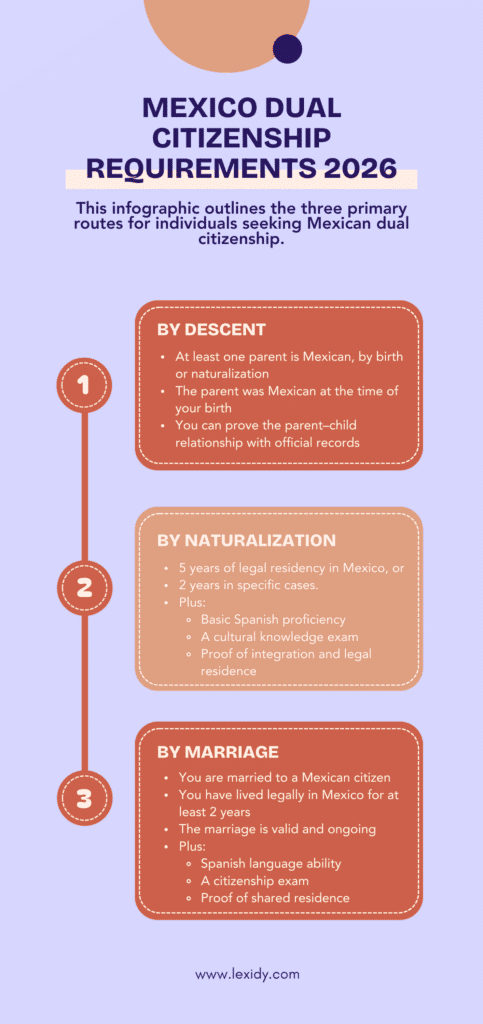
There are three main legal pathways to obtain dual citizenship in Mexico. The right option depends on family ties, length of residence, or marriage status.
Citizenship by Descent (Mexican Parent)
This is the most straightforward route. You may qualify if:
- At least one parent is Mexican, by birth or naturalization
- The parent was Mexican at the time of your birth
- You can prove the parent–child relationship with official records
There is:
- No residency requirement
- No Spanish language test
- No age limit
Many applicants already qualify by law and only need to register their Mexican nationality.
Citizenship by Residency (Naturalization)
This pathway applies when there is no Mexican parent. General requirements include:
- 5 years of legal residency in Mexico, or
- 2 years in specific cases, such as:
- Marriage to a Mexican citizen
- Having Mexican children
- Being from a Latin American or Iberian country
Additional requirements:
- Basic Spanish proficiency
- A cultural knowledge exam
- Proof of integration and legal residence
Citizenship by Marriage
Marriage alone does not grant citizenship, but it can reduce residency time. You may qualify if:
- You are married to a Mexican citizen
- You have lived legally in Mexico for at least 2 years
- The marriage is valid and ongoing
This route still requires:
- Spanish language ability
- A citizenship exam
- Proof of shared residence
At-a-glance comparison
| Pathway | Residency Required | Language Test | Exam |
| Descent (Mexican parent) | ❌ No | ❌ No | ❌ No |
| Residency (naturalization) | ✅ Yes | ✅ Yes | ✅ Yes |
| Marriage to Mexican citizen | ✅ Yes (reduced) | ✅ Yes | ✅ Yes |
Understanding which pathway applies is critical. Many delays happen because applicants start the wrong process.
How to Apply for Dual Citizenship in Mexico: Step by Step

Applications are filed with the Secretaría de Relaciones Exteriores (SRE), either in Mexico or through a Mexican consulate abroad, depending on the pathway.
Step 1: Confirm the correct pathway
Before anything else, confirm whether you qualify through:
- Descent (Mexican parent)
- Residency (naturalization)
- Marriage (reduced residency)
Starting under the wrong route is the most common cause of delays.
Step 2: Gather required documents
While documents vary by pathway, most applications include:
- Birth certificate (apostilled and translated, if issued abroad)
- Valid passport and immigration status
- Proof of Mexican parentage, residency, or marriage
- Government-issued ID
Documents must be recent and consistent across records.
Step 3: Submit the application
Applications are filed with the SRE in Mexico or at a Mexican consulate if applying from abroad. At submission:
- Forms are reviewed
- Fees are paid
- Biometrics may be collected
Step 4: Exams and interviews (if required)
Applicants applying through residency or marriage must usually complete:
- A basic Spanish language test
- A Mexican history and culture exam
Applicants by descent are typically exempt.
Step 5: Receive approval and register citizenship
Once approved:
- Citizenship is formally registered
- You can apply for a Mexican birth certificate
- You can then request a Mexican passport
Timelines to expect
- Descent: Often a few months
- Residency or marriage: 6–12 months, depending on location and workload
Mexico Dual Citizenship Advantages
Holding dual citizenship in Mexico offers practical benefits that go well beyond having a second passport. For many applicants, these advantages are the main reason to move forward.
Live and work freely
Mexican citizenship allows you to live and work in Mexico without visas, renewals, or minimum stay requirements. Employment, self-employment, and business ownership are all permitted without additional authorization.
Easier property ownership
While foreigners can buy property in Mexico, citizens face fewer restrictions and less administrative complexity. This is especially relevant for long-term ownership, coastal or border properties, and inheritance planning.
Long-term security
Citizenship is permanent. It does not expire and is not tied to income, employment, or time spent in Mexico. Once approved, your status remains secure even if immigration rules change.
Greater flexibility
Holding two passports gives you the freedom to enter and exit Mexico freely while keeping full rights in your other country of citizenship. This flexibility is especially valuable for people splitting time between countries.
“For many people, the biggest advantage of Mexican citizenship is stability. Once you are a citizen, your right to live, work, and own property in Mexico is no longer tied to visas, renewals, or changing immigration rules,”
Francisco Tolentino, Immigration Lawyer
FAQs: Dual Citizenship in Mexico

How long does it take to get Mexican dual citizenship?
Timelines depend on the pathway. Citizenship by descent often takes a few months, while residency or marriage-based applications usually take 6 to 12 months, depending on workload and location.
Do I need to speak Spanish to apply for dual citizenship in Mexico?
Spanish is not required for citizenship by descent. Applicants applying through residency or marriage must usually pass a basic Spanish language test and a cultural knowledge exam.
Can I apply for dual citizenship from outside Mexico?
Yes. Applications by descent can often be started through a Mexican consulate abroad. Residency and marriage-based applications typically require time spent legally living in Mexico.
Can my children get Mexican dual citizenship too?
Yes. Children of Mexican citizens are generally eligible for citizenship by descent, even if they are born outside Mexico.
Will Mexican citizenship affect my U.S. or Canadian citizenship?
No. Mexico allows dual citizenship, and countries like the United States and Canada also permit it. You can hold both nationalities at the same time.
Is Dual Citizenship in Mexico Right for You?
For many people, dual citizenship in Mexico offers long-term security, flexibility, and peace of mind. Mexico fully allows dual nationality, and whether eligibility comes through a Mexican parent, years of legal residence, or marriage, the legal pathways are clear and well established.
The right route depends on personal circumstances. Citizenship by descent is usually the simplest and fastest option. Residency and marriage-based routes take longer and involve exams, but they can still be a strong solution when no family link exists.
Not sure which pathway applies or whether the documents are in order? Our trusted Mexican immigration lawyers are here to help. Simply fill out the form below to get a clear eligibility assessment and understand the next steps before starting the process.