French citizenship by descent allows individuals with a direct French parent to claim French nationality through ancestry. This pathway, known legally as citizenship by filiation, is based on the principle of jus sanguinis, or right of blood. Unlike naturalization, it does not require years of residence in France or passing a French language test.
French nationality is not an exception or a rare outcome. Each year, more than 100,000 people acquire French nationality through various legal routes, including birthright, declaration, and family-based procedures, according to official data published by the French Ministry of the Interior.
If at least one parent was French at the time of birth, nationality may already exist by law. The process focuses on proving a direct family link through official documents, not on integration or residency requirements.
This guide explains who qualifies, what documents are required, how long the process takes, and how to apply, while clearing up common misconceptions around grandparents and ancestry.
French citizenship by descent is the legal right to French nationality based on citizenship by filiation. In simple terms, nationality is passed from parent to child through bloodline, not through place of birth or years lived in France.
This principle is known as jus sanguinis, or right of blood. If a parent was French at the time of a child’s birth, the child is considered French by law, even if they were born outside France and have never lived there.
How Does This Differ From Naturalization?
Citizenship by descent is fundamentally different from becoming French through naturalization.
Key differences include:
No minimum residency period in France
No French language test
No integration or cultural exam
No discretionary assessment by the authorities
The process is not about “applying to become French.” It is about proving an existing right to French nationality through official records.
The Most Important Rule to Understand
Eligibility depends entirely on the parents’ nationality, not on family history, cultural ties, or residency. Where the child was born and where the family lived are not deciding factors.
This point is often misunderstood, especially by applicants who assume French rules work the same way as other ancestry-based citizenship systems.
Who Qualifies for French Citizenship by Descent?
In short, you qualify for French citizenship by descent if at least one of your parents was a French citizen at the time of your birth.
This rule is strict and leaves little room for interpretation. French nationality by descent is automatic by law when the condition is met. The application process exists only to prove that status through documentation.
Eligibility Criteria
To qualify, all of the following must apply:
You have at least one French parent
That parent was already a French citizen when you were born
The rule applies regardless of where you were born
There is a clear, documented link between you and your French parent
Residency in France, cultural ties, and language ability do not affect eligibility.
Eligibility at a Glance
Scenario
Eligible for Citizenship by Descent?
Born abroad to one French parent
✅ Yes
Born in France to one French parent
✅ Yes
French grandparent, non-French parent
✅Yes (in certain cases)
French ancestry but no French parent
❌ No
Why are Applications Often Rejected?
When applications are refused, it is usually because:
The parent was not French at the time of birth
Citizenship was acquired later by the parent
Documents do not clearly establish the chain of nationality
Understanding this rule early prevents wasted time and unrealistic expectations.
Can Grandchildren Qualify for French Citizenship by Descent?
In most cases, no. French citizenship by descent requires a direct French parent, not a grandparent. However, there is an important clarification that often gets missed.
The Rule That Matters
French citizenship by descent is passed from parent to child only. Having a French grandparent on its own does not create automatic eligibility, but it is possible in certain cases to obtain French citizenship via your grandparents.
That said, what matters legally is whether your parent was already French at the time of your birth, not when they apply for documents.
The Common Misunderstanding
Some parents never registered their French nationality, even though they were already French by law through their own parent.
In those cases:
The parent may apply now to confirm their French nationality
If that nationality existed when you were born, you may also qualify
The application confirms an existing status, it does not create a new one.
What does not work:
A parent becoming French later through naturalization after you were born
A French great-grandparent who has left France more than 50 years ago.
Citizenship cannot be passed retroactively.
How to Think About This Simply
Situation
Eligible for Citizenship by Descent?
You had a French parent at the time of your birth
✅ Yes
You only have a French grandparent
✅ Yes (in certain cases)
Your parent was already French by law but never registered it
✅ Potentially, after confirmation
Your parent applies now to confirm existing French nationality
✅ Possible pathway
Your parent becomes French later after your birth through naturalization
❌ No
Your parent was not French at your birth (no French parent)
❌ No
This distinction explains why many cases require a legal review before applying. Have questions? Our trusted immigration lawyers in France are here to provide a detailed review of your case and assist with your application.
What Documents Do You Need for French Citizenship by Descent?
In general, you need 3 to 4 generations of civil status documents to prove an unbroken chain of French nationality from your French parent to you.
The goal is simple. Show, on paper, that French citizenship legally passed from parent to child.
Core Documents Required
Most applications include the following:
Your full birth certificate: Apostilled and translated into French
Your French parent’s birth certificate: Issued by the French civil registry
Proof of your parent’s French nationality: French passport, French ID card, or certificat de nationalité française
Marriage certificates (if applicable): Required when surnames changed through marriage
Additional civil records: Divorce decrees or name-change documents if relevant
All non-French documents must be:
Apostilled or legalized (depending on the country of origin)
Translated by a sworn French translator registered at a Cour d’appel in France
Practical Details to Expect
To help with planning, here are typical figures applicants encounter:
Certified translations: €25–50 per page
Apostille processing time: 2–4 weeks per document
Document requests: Older records may take longer to obtain
Incomplete or incorrectly prepared documents are the number one reason applications are delayed.
Common Document Mistakes to Avoid
These issues come up repeatedly:
Short-form birth certificates instead of full versions
Apostilles issued by the wrong authority
Translations done by non-certified translators
And inconsistency between surname and first name on your civil status documents.
A Note on French Authorities
Applications are reviewed by the French chief clerk of the district court. If you are living outside of France, you need to submit your application in original documents at the civil court in Paris.
They assess documentation strictly. Even small inconsistencies can trigger requests for clarification, adding months to the timeline.
Do You Need to Speak French to Qualify?
No. There is no French language requirement for citizenship by descent. This is one of the biggest advantages of the descent pathway and a major point of confusion for applicants.
Why Language is Not Required
French citizenship by descent is based on filiation, not integration. The law assumes nationality already exists through a French parent, so there is no requirement to prove language skills, cultural knowledge, or time spent in France.
That means:
No French language test
No interview
No minimum proficiency level
How This Compares to Naturalization
The rules are very different for other citizenship routes.
Pathway
French Language Requirement
Citizenship by Descent
❌ None
Citizenship by Naturalization
✅ B2 level in French required
For many applicants, this distinction is decisive. Even fluent French speakers often choose the descent route when eligible because it avoids discretionary assessments entirely.
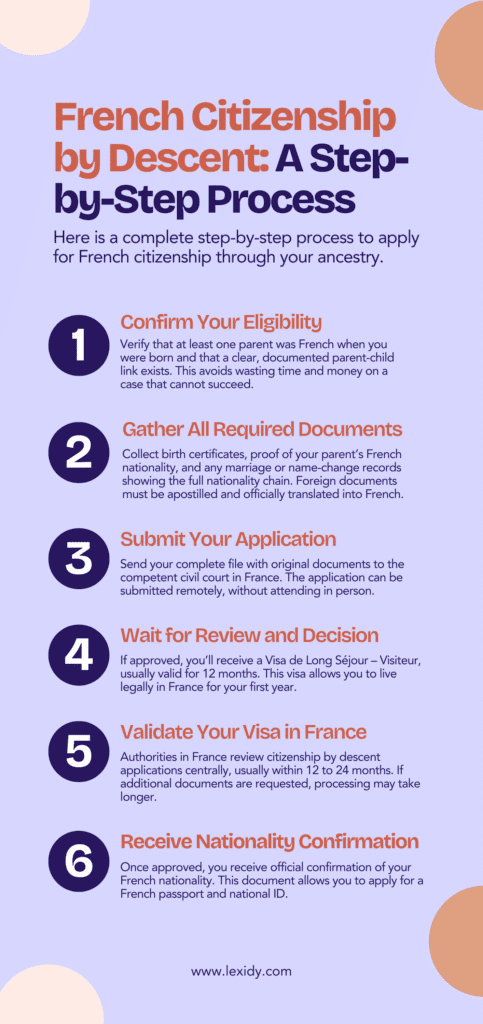
How to Apply for French Citizenship by Descent: Step-by-Step Process
If you want to apply directly for a French passport, you need to request it in front of the French Consulate. If you want to obtain a French nationality certificate (often mandatory to obtain your French passport), then you need to submit your application at the civil court directly in France.
Below is the process most applicants follow.
Step 1: Confirm Eligibility
Start by confirming that:
At least one parent was French at the time of your birth
There is a clear, documented parent–child link
This check prevents investing time and money in a case that cannot succeed.
Step 2: Gather All Required Documents
Collect civil status records showing the full chain of nationality, including:
Birth certificates
Proof of your parent’s French nationality
Marriage or name-change records, if applicable
All foreign documents must be apostilled and translated into French by a sworn translator registered at a Cour d’appel in France.
“In most cases, delays do not come from the law itself, but from missing or improperly prepared documents. Citizenship by descent is very strict on paperwork, but very predictable when the file is complete.”
Eléonore Tavares, Head of Lexidy France
Step 3: Submit Your Application at the French Civil Court
You need to send your file in original documents to the competent court in France. You do not need to submit it in person.
Step 4: Wait for Review and Decision
Citizenship by descent applications are reviewed centrally in France. Typical timelines:
Average processing time: 12–24 months
Requests for additional documents can extend this period
Decisions are communicated by registered mail.
Step 6: Receive Confirmation of French Nationality
If approved, you receive official confirmation of your French nationality. This document allows you to apply for French identity documents.
How Long Does the French Citizenship by Descent Application Take?
Most French citizenship by descent applications take 12 to 24 months from submission to final decision.
Applications are reviewed centrally in France. There is no interview, and the process focuses on verifying documents rather than assessing integration.
Typical stages include document review and civil status checks. Delays most often occur when documents are missing, incorrectly apostilled, or require clarification.
“When the file is complete, timelines are generally predictable. Most delays happen because documents need to be corrected or replaced.”
Eléonore Tavares, Head of Lexidy France
How Much Does It Cost to Apply for French Citizenship by Descent?
Typical costs to expect
Expense
Estimated Cost
Certified Translations
€100–200
Apostille Stamps
€30–100
Document Requests
€20–100
Costs vary depending on how many documents need translation or apostilles and how many countries are involved. The application fee itself is free; preparation is where most expenses arise.
Can You Keep Your Current Citizenship?
Yes. France allows dual citizenship, so you do not need to renounce your current nationality when you acquire French citizenship by descent.
France has recognized dual nationality since 1973, and this applies to most applicants. Countries such as the United States, the United Kingdom, Australia and Canada also allow dual citizenship.
The only caveat is your other country’s rules. Some nationalities restrict dual citizenship, so it is worth confirming before applying.
What Happens After Your Application Is Approved?
Once approved, you receive confirmation of French nationality and can immediately apply for a French passport and national ID card.
The Next Steps
After approval, most applicants follow this sequence:
Receive your French nationality confirmation: This is the official proof that you are French.
Apply for a French passport: Processing usually takes 4–6 weeks. The standard fee is €86 for adults.
Apply for a French national ID card (optional): Useful for travel and identification within the EU.
Register with a French consulate (if living abroad): This simplifies future renewals and administrative steps.
What You Gain Immediately
Approval gives you:
The right to live and work in France and the EU
Visa-free travel with a French passport
Access to French consular protection abroad
Political rights, including voting in French elections
Frequently Asked Questions About French Citizenship By Descent
Why was my application rejected?
Most refusals happen because the parent was not French at the time of birth or the document chain is incomplete. Missing apostilles, uncertified translations, or gaps between generations are the most common issues.
Does France allow dual citizenship?
Yes. France allows dual nationality. Just be sure your other country also permits it before applying.
Can I apply if my French parent never registered their citizenship?
Possibly. If your parent was already French by law at the time of your birth, they can first confirm their nationality. Your eligibility depends on their legal status when you were born, not when they apply.
Is there an age limit to apply for French Citizenship by Descent?
No, adults and minors can apply as long as eligibility is proven.
Do I need to live in France or speak French?
No. There is no residency or language requirement for citizenship by descent.
How is French citizenship by descent different from other pathways?
Citizenship by descent is based on parentage, not residence or integration. Other routes, like naturalization, require living in France for years and meeting language requirements.
Pathway
Citizenship by Descent
Citizenship by Marriage
Citizenship by Naturalization
Basis
French parent (filiation)
Marriage to a French Citizen
✅ Yes (usually 4–5 years)
Residency Required
❌ No
✅ Yes (usually 4–5 years)
✅ Yes (usually 5 years)
French Language Test
❌ No
✅ Yes (B2 level)
✅ Yes (B2 level)
Discretionary Decision
❌ No
⚠️ Partial (administrative review)
✅ Yes
Processing Time
12-24 months
12-18 months
12-24 months
BestFor
Those with a French parent
Spouses of French Citizens
Long-term residents without French parents
Is French Citizenship by Descent the Right Path for You?
If you have a French parent, citizenship by descent can be one of the most straightforward ways to obtain French nationality. It is based on law, not discretion, and avoids the residency and language requirements tied to other pathways.
Eligibility comes down to one key factor: your parents’ nationality at the time of your birth. When that link is clear and documents are properly prepared, the process is predictable, even if it takes time.
Not sure if you qualify or whether your documents are sufficient? Our experienced French citizenship lawyers are here to help. Fill out the form below to get a clear eligibility assessment and understand the next steps before moving forward.
 Skip to content