 Skip to content

If you are a highly skilled non-EU professional planning to work in Spain, the EU Blue Card Spain is one of the most strategic residence options available in 2026. It combines the right to live and work in Spain with a longer-term goal that goes beyond national borders: professional mobility across the European Union.
Spain also offers a national fast-track option, the Highly Qualified Professional (HQP) permit. Both routes are designed for senior profiles, university graduates, and managers, and both offer streamlined processing. The key difference is scope. The EU Blue Card is built for professionals who want future flexibility within the EU, while the HQP permit is focused purely on Spain.
This guide explains how the EU Blue Card works in Spain, who qualifies, the updated 2025-2026 salary thresholds, and how the application process compares to the HQP route. The goal is simple. Help employers and candidates choose the permit that best supports both immediate hiring needs and long-term career plans.
(Article Updated January 2026)
Table of Contents
- EU Blue Card Requirements in Spain: Qualifications and Job Contract
- EU Blue Card Spain Salary Thresholds (2025-2026)
- EU Blue Card Spain Application Process: Step by Step
- EU Blue Card Fees and Validity
- EU Blue Card vs. HQP Permit: Which Option Makes More Sense?
- Family Reunification and Long-Term Status Under the EU Blue Card
- Is the EU Blue Card the Right Choice for Spain?
EU Blue Card Requirements in Spain: Qualifications and Job Contract
To qualify for the EU Blue Card Spain, applicants must meet a clear set of professional and employment requirements. These rules are designed to ensure the role is genuinely highly skilled and that the employment relationship is stable and compliant.
1. Binding Job Offer or Employment Contract
A valid job offer is mandatory. The offer must:
- Be for a highly qualified position
- Have a minimum duration of six months
- Clearly state the guaranteed gross salary
- Comply with Spanish labor standards
Short-term or informal contracts do not qualify.
2. Professional Qualifications
Applicants must meet one of the following qualification routes:
- Higher education pathway
- A recognized higher education qualification
- Typically a bachelor’s degree or higher (EQF Level 6 or equivalent)
- Professional experience pathway
- At least 5 years of relevant professional experience, or
- 3 years of experience for ICT managers or professionals gained within the last 7 years
- This alternative route is especially relevant for senior profiles without a formal university degree.
3. Employer Compliance in Spain
The Spanish employer plays a central role in the process. The employer must:
- Be properly registered in Spain
- Be up to date with tax and social security obligations
- Demonstrate the role fits a highly qualified profile
If the employer does not meet these criteria, the application will not move forward, even if the candidate qualifies.
Meeting the education or experience threshold alone is not enough. The job offer, salary level, and employer compliance must all align. When one element is missing or unclear, this can often cause application delays or rejection.
EU Blue Card Spain Salary Thresholds (2025-2026)
Salary is one of the most decisive factors when applying for the EU Blue Card Spain. The threshold must be met in the employment contract itself, and only the guaranteed gross salary counts. Bonuses, benefits, stock options, or allowances cannot be used to reach the minimum.
Note: Spain has extended the 2025 SMI (Salario Minimo Interprofesional) through 2026, meaning salary thresholds remain unchanged. However, a mid-2026 adjustment is possible if social dialogue negotiations conclude with a new agreement.
Below are the 2025-2026 salary benchmarks the Spanish immigration authorities use.
| Applicant Profile | Minimum Gross Annual Salary | Coefficient Used |
| Standard skilled professional | 40,077 EUR | 1.5x average Spanish salary |
| Directors and managers | 54,142 EUR | Higher threshold for senior roles |
| High-demand professions (IT, healthcare, engineering) | 32,062 EUR | 0.8x standard threshold |
| Reduced rate (under 30 years old / recent graduates) | 30,058 EUR | 0.75 reduction |
Important salary rules to know
- The salary must be explicitly stated in the contract
- Variable pay and benefits do not count
- The threshold applies per year, not monthly
- Falling below the minimum is a common reason for refusal
For employers, this means structuring the compensation package correctly from the start. For candidates, it means verifying that the contract meets the threshold before the application is filed.
EU Blue Card Spain Application Process: Step by Step
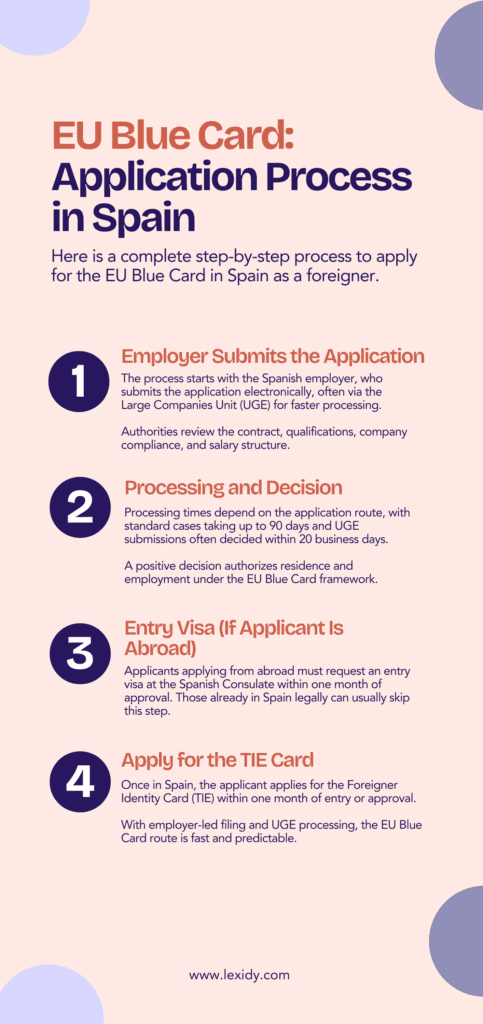
The EU Blue Card Spain application follows a structured, employer-driven process. One of its advantages is flexibility. In many cases, the application can begin while the candidate is already in Spain, as long as their stay is legal.
Step 1: Employer Submits the Application
The process begins with the Spanish employer, not the employee.
- The employer submits the application electronically
- Usually, the employer files through the Large Companies Unit (UGE) for faster handling
- Supporting documents include the employment contract, proof of qualifications, and company compliance records
At this stage, salary structure and job role are reviewed closely.
Step 2: Processing and Decision
Processing timelines depend on where and how you file the application.
- Standard processing: up to 90 days
- UGE processing: often 20 business days
A favorable resolution authorizes employment and residence under the EU Blue Card framework.
Step 3: Entry Visa (If the Applicant Is Abroad)
If the applicant is outside Spain, an additional step applies.
- The employee must apply for an entry visa at the Spanish Consulate
- You msut do this within one month of receiving approval
- The visa allows entry into Spain to begin employment
Applicants already in Spain legally can usually skip this step.
Step 4: Apply for the TIE Card
Once in Spain, the final step is administrative.
- The applicant must apply for the Foreigner Identity Card (TIE)
- This must be done within one month of entry or approval
- Biometrics are taken and the residence card is issued
The EU Blue Card route is predictable and fast when prepared correctly. Employer-led filing reduces uncertainty, and UGE processing can significantly shorten timelines for urgent hires.
EU Blue Card Fees and Validity
| Application fee (initial) | 73.26 EUR |
| Card issuance fee (initial) | 16.08 EUR |
| Renewal application fee | 78.67 EUR |
| Renewal/replacement card fee | 19.30 EUR |
The EU Blue Card is valid for 3 years and can be renewed for 2 years, paving the way to a long-term residence permit.
EU Blue Card vs. HQP Permit: Which Option Makes More Sense?
Both the EU Blue Card Spain and the Highly Qualified Professional (HQP) permit are fast-track routes for skilled non-EU professionals. On the surface, they look similar. In practice, they serve different long-term goals.
The table below highlights the key differences that matter most to candidates and employers.
| Feature | EU Blue Card | HQP Permit |
| EU mobility | Yes. Allows easier move to another EU country after 12 months | No. Valid only for Spain |
| Qualification alternative | At least 5 years of experience (or 3 years for ICT profiles within the last 7 years) | At least 3 years of professional experience |
| Salary threshold | Higher minimum salary required (40,077 EUR standard) | Lower than EU Blue Card in most cases |
| Processing time | Up to 90 days (often 20 business days via UGE) | Up to 20 business days via UGE |
| Geographic scope | Spain plus future EU mobility | Spain only |
| Long-term outcome | Leads to EU Long-Term Resident status after 5 years | Leads to Spanish Permanent Residency after 5 years |
| High-demand professions | Reduced threshold (0.8x) for IT, healthcare, engineering | Similar reductions may apply |
| Best for | Candidates prioritizing future EU flexibility | Candidates focused exclusively on Spain |
How to choose between the two
The decision usually comes down to future plans.
- The EU Blue Card is ideal for professionals who want the option to work in other EU countries later on. It trades a higher salary requirement for broader mobility.
- The HQP permit works well for candidates and employers who want speed and have no plans beyond Spain.
For employers, the HQP route can be faster. For candidates thinking long term, the EU Blue Card offers strategic flexibility that the national permit does not.
Need help deciding? A trusted immigration advisor can help guide to to the right choice for your long-term plans in Spain.
Family Reunification and Long-Term Status Under the EU Blue Card

One of the strongest advantages of the EU Blue Card Spain is how it supports family relocation and long-term stability from day one.
Family Reunification Rights
EU Blue Card holders can apply for family members at the same time as the main application or immediately after approval.
Eligible family members include:
- Spouse or registered partner
- Underage dependent children
Key benefits for families:
- Family members receive a residence permit with immediate work authorization
- No labor market test is required for spouses
- The process is streamlined compared to standard family reunification routes
In practice, this means a partner can legally work in Spain as soon as their residence card is issued, without waiting periods or additional permits.
Path to Long-Term Residence
The EU Blue Card is designed with long-term settlement in mind.
- After five years of legal residence in the EU:
- The holder can apply for EU Long-Term Resident status
- At least the final two years must have been spent in Spain
This status provides:
- Stronger residence security
- Easier mobility and residence rights in other EU countries
- Fewer renewal requirements over time
For comparison, the HQP permit leads only to Spanish permanent residence, not EU-wide long-term status.
Is the EU Blue Card the Right Choice for Spain?
For highly skilled non-EU professionals, the EU Blue Card offers a clear path to work in Spain while keeping future EU mobility open. Updated 2025-2026 salary thresholds and streamlined rules make it a strong option for candidates planning beyond a single country.
However, it is not always the best fit. The HQP permit can be faster and more practical when long-term EU mobility is not a priority. The right choice depends on salary level, qualifications, employer readiness, and future plans.
When these factors align, the EU Blue Card provides both stability in Spain and flexibility across Europe.
Ready to get started? An experienced immigration lawyer can help you understand your eligibility, prepare your application and streamline your move to Spain.