 Skip to content

Greece allows dual citizenship, with no restrictions on how many nationalities a person may hold. This includes full compatibility with U.S. nationality.
For anyone exploring how to get dual citizenship in Greece, there are two primary legal pathways:
- Citizenship by Descent (Jus Sanguinis) – for those with Greek ancestry.
- Citizenship by Naturalization – for long-term residents, including EU nationals, non-EU nationals and Golden Visa holders.
Securing dual citizenship in Greece is more than a legal status. It opens the door to one of the most valuable travel and mobility assets in the world: an EU passport. Once you apply for dual citizenship in Greece and are approved, you gain the right to live, work, study, and retire in any EU or EEA country, dramatically expanding your opportunities globally.
This guide outlines the Greece dual citizenship requirements, the eligibility rules for each citizenship route, and what applicants need to know in 2025.
Table of Contents
- Path 1: Citizenship by Descent (Jus Sanguinis)
- Path 2: Citizenship by Naturalization (Residency)
- Naturalization via the Greek Golden Visa
- Advantages of Greek Dual Citizenship
- Responsibilities of Greek Dual Citizenship
- The Application Process and Timeline
- Key Steps in Every Application Path
- Ready to Apply for Dual Citizenship in Greece?
Path 1: Citizenship by Descent (Jus Sanguinis)
For most individuals with Greek ancestry, the easiest and most direct way to apply for dual citizenship in Greece is through citizenship by descent, also known as Jus Sanguinis (“right of blood”). Greece has one of the world’s most generous ancestry-based citizenship laws, making this the most accessible route for those with Greek heritage.
Eligibility: Citizenship Through the Bloodline
You may apply for dual citizenship in Greece if you have a Greek parent, grandparent, or great-grandparent. In practice, there is no strict generational limit, and you can apply as long as every link in the lineage can be proven and the chain of Greek nationality was never legally broken.
This means:
- If your parent or grandparent never formally renounced Greek nationality, you may still qualify.
- Even distant ancestry can qualify, as long as documentation exists to trace the entire bloodline.
The Link Is Key: Proving Your Lineage
To obtain dual citizenship in Greece, you must provide official evidence connecting each generation back to your original Greek ancestor. This typically includes:
- Certificates from Greek Municipality and Registries
- Birth certificates
- Marriage certificates
- Sometimes, baptismal records or family registry entries
Greek authorities will cross-check these documents with municipal records to confirm eligibility.
Documentation Checklist
To meet Greece’s dual citizenship requirements, all foreign documents must be:
- Apostilled or officially certified
- Translated into Greek (either by the Greek Ministry of Foreign Affairs, a Greek Consulate, or a certified translator)
Common documents required include:
- Birth, marriage, and death certificates across each generation
- Name-change records
- Proof of the Greek ancestor’s place of origin (village, municipality, or family registry)
Ensuring early accuracy and consistency (names, spelling, dates) will significantly speed up the approval process. Discover everything you need to know about Greek Citizenship by Descent, from eligibility and application to common mistakes to avoid.
Path 2: Citizenship by Naturalization (Residency)
If Citizenship by Descent isn’t an option for you, citizenship by naturalization is the most structured, and often the most demanding path. This is the route most relevant to long-term non-EU residents, foreign spouses, and those trying to get dual citizenship in Greece without Greek heritage.
Residency Requirement
To apply for dual citizenship in Greece through naturalization, the law requires a minimum period of legal residency:
- Seven years of continuous legal residency in Greece for most applicants.
- Three-year residency for eligible fast-track categories:
- Spouses of Greek citizens
- Citizens of EU member states
- Parents of a minor child who is a Greek citizen
Applicants must be able to demonstrate that they lived in Greece legally and continuously during this period, supported by residency permits, tax declarations, and municipal records.
Language and Knowledge Exam
Since 2021, Greece has introduced an exam to ensure applicants can integrate successfully into Greek society. Anyone seeking dual citizenship in Greece through naturalization must now:
- Prove Greek Language Proficiency at B1 Level. This includes reading, writing, listening, and speaking components.
- Pass the Greek Knowledge Exam.This assesses understanding of:
- Greek history
- Culture and traditions
- Geography
- Greece’s political system and constitution
Many applicants prepare for the exam using the official study bank, which contains 300+ questions.
Other Mandatory Requirements
To qualify for dual citizenship through naturalization, applicants must also:
- Be 18 years or older
- Maintain a clean criminal record
- Prove tax compliance in Greece
- Show financial self-sufficiency (employment, savings, or other stable income sources)
For non-EU nationals, including Golden Visa holders, naturalization offers a clear, legally defined path. This pathway requires commitment to long-term residency and successful completion of the language and knowledge exams. Read our complete guide to Greek Citizenship by Naturalization.
Naturalization via the Greek Golden Visa

For many investors wondering how to get dual citizenship in Greece or whether the Golden Visa leads to citizenship, this is one of the most important clarifications.
The Golden Visa is a Residency Route (Not Citizenship)
Greece’s Golden Visa is one of Europe’s most accessible investment residency programs, requiring a real estate investment typically between €400,000 and €800,000, depending on the region.
However, holding a Golden Visa does not grant Greek citizenship automatically and does not shorten the naturalization timeline.
This option provides residency rights only, which can later support an application for dual citizenship in Greece through naturalization.
Eligibility for Citizenship as a Golden Visa Holder
Golden Visa residents may apply for citizenship after seven years of continuous legal residency. This is the same timeline as any other non-Greek resident.
This is a critical point for anyone researching the dual citizenship requirements in Greece, because the Golden Visa alone is not enough. You still must qualify through the standard naturalization framework.
The Physical Presence Requirement
The Golden Visa has become popular partly because it does not require applicants to physically live in Greece to maintain residency.
However, if your long-term goal is to obtain Greek dual citizenship, the rules change:
To naturalize, you must demonstrate genuine physical presence in Greece over those seven years. You must spend a meaningful portion of each year living in the country.
To break that down:
- You can maintain a Golden Visa without living in Greece.
- You cannot obtain citizenship without living in Greece.
This distinction is essential for any non-EU investor because the pathway is open, but requires true integration through residency, language proficiency, and cultural knowledge. Learn the in’s and out’s of the Greek Golden Visa.
Advantages of Greek Dual Citizenship
Gaining dual citizenship in Greece is more than just a legal status. It’s an upgrade to your mobility, opportunities, and global lifestyle. But dual nationals also take on certain obligations. Here is what life looks like once you hold a Greek passport.
EU Passport Power:
As a Greek and EU citizen, you can live, work, study, or retire anywhere in the EU/EEA, with no visas or residency renewals required. This freedom of movement is one of the strongest motivators for those researching how to get dual citizenship in Greece.
Political Rights:
Dual citizens gain the right to vote in Greek national elections, local elections, and European Parliament elections even if living abroad (under certain registration rules).
Legacy for Future Generations:
Greek citizenship is passed automatically to your children, ensuring your lineage secures EU citizenship benefits long term. This is a major reason many applicants choose to apply for dual citizenship in Greece through ancestry or naturalization.
Responsibilities of Greek Dual Citizenship

Military Service
Male Greek citizens aged 19 to 45 are legally required to complete compulsory military service, including many dual citizens born and living abroad. Skipping service is taken seriously and can lead to fines or being declared a deserter, with long-term legal consequences.
That said, exemptions, reduced service, or long-term deferments may apply, mainly for those who can prove permanent residence abroad. For most dual citizens with Greek ancestry, the key is understanding the rules early and confirming whether an overseas resident exemption applies.
Taxation
Tax obligations depend on residency, not citizenship.
- If you live in Greece, you are taxed on your worldwide income under Greek law.
- Dual Greek–US citizens must still comply with U.S. annual tax filing rules, including FBAR/FATCA reporting.
Being a dual citizen of Greece does not automatically trigger taxation in Greece if you reside abroad. Want to find out your exact tax obligations? Get legal clarity on Greek dual citizenship.
The Application Process and Timeline
Applying for dual citizenship in Greece—whether through ancestry or residency—requires patience and careful preparation. While eligibility criteria differ by pathway, the overall timeline reflects the procedural reality of Greece’s civil registries, consulates, and Ministry of Interior.
Citizenship by Descent (Consulate Route): 1–4 Years
For applicants seeking Greek citizenship through ancestry, the timeline varies widely. Cases with well-preserved documentation and straightforward lineage may be processed in as little as 12 months. Complex family trees, missing records, or multiple generational links can extend processing up to four years.
Much of the wait occurs at the local Greek municipality, where foreign documents must be verified, and the family registry entry must either be created or updated.
Naturalization-Based Applications: 1–2 Years
This timeline generally applies to standard naturalization based on residence in Greece. Greeks abroad who cannot apply by descent follow a different, consulate-based naturalization path, which has its own process and timelines.
Key Steps in Every Application Path
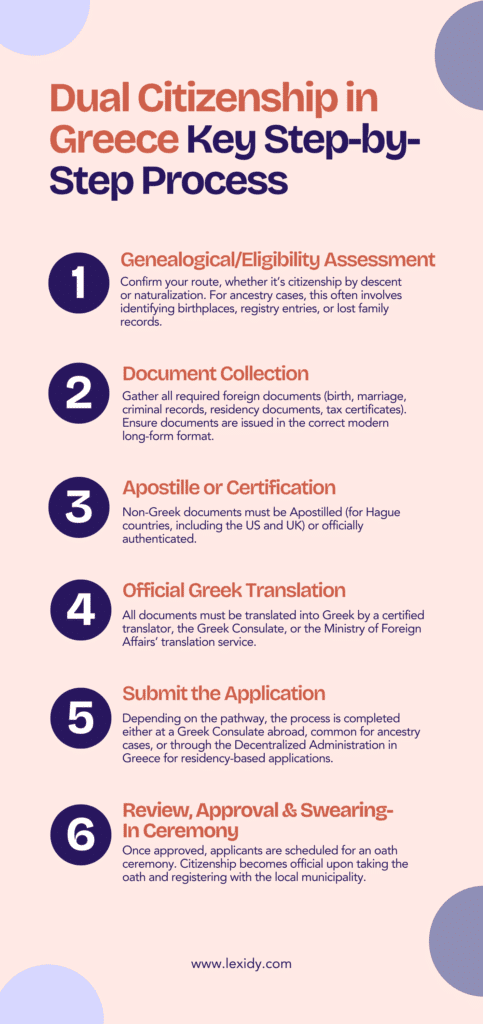
Regardless of whether you are going to apply for dual citizenship in Greece through descent or residency, all applicants follow a similar structural process:
1. Genealogical or Eligibility Assessment
Confirm your qualifying route, whether it’s citizenship by descent or residency-based naturalization. For ancestry cases, this often involves identifying birthplaces, registry entries, or lost family records.
2. Document Collection
Gather all required foreign documents (birth, marriage, criminal records, residency documents, tax certificates). Ensure documents are issued in the correct modern long-form format.
3. Apostille or Certification
Non-Greek documents must be Apostilled (for Hague countries, including the US and UK) or officially authenticated.
4. Official Greek Translation
All documents must be translated into Greek by a certified translator, the Greek Consulate, or the Ministry of Foreign Affairs’ translation service.
5. Application Submission
Depending on your path, this is completed either:
- At a Greek Consulate abroad (most common for ancestry cases), or
- At the Decentralized Administration in Greece (for residency-based applicants).
6. Review, Approval & Swearing-In Ceremony
Once approved, applicants are scheduled for an oath ceremony. Citizenship becomes official upon taking the oath and registering with the local municipality.
Ready to Apply for Dual Citizenship in Greece?
Obtaining dual citizenship in Greece is one of the most effective ways to reclaim your heritage, secure long-term EU mobility, or build a future within the European Union. Whether your path is through descent, naturalization, or long-term residency, such as the Golden Visa, the result is the same: full Greek citizenship and the life-changing benefits of an EU passport.
The entire process can feel overwhelming without expert guidance. If you want professional, end-to-end assistance with your Greek citizenship application, our Greek immigration team can handle everything from eligibility confirmation to document preparation and filing.
Ready to apply for Greek dual citizenship? Fill out the form below today and speak to a Greek immigration specialist.