 Skip to content

Thinking about moving to Portugal from the USA in 2026? Whether the plan is retirement, remote work, or a fresh start with family, one rule applies to all Americans. Stays longer than 90 days require a Portuguese residency visa, secured before arriving in Portugal.
The biggest decision comes early. Which visa fits the situation? For most U.S. citizens, the choice comes down to income source:
- Passive income, such as pensions, rental income, or investments
- Active income, earned through remote work or freelance contracts
This is where the D7 Visa and D8 Digital Nomad Visa come into play. Each has different financial thresholds, documentation requirements, and long-term implications. Choosing the wrong option can delay the move or lead to a refusal.
This guide walks through the real requirements, updated income thresholds, and the full process step by step. From getting a Portuguese tax number to attending the final appointment after arrival, the goal is simple. Make moving to Portugal feel predictable, realistic, and well planned before any big decisions are made.
Table of Contents
- The Main Visa Routes for Americans Moving to Portugal
- Other Residency Options Americans Often Ask About
- Step-by-Step Checklist for Americans Moving to Portugal
- Pros and Cons of Moving to Portugal from the USA
- Full Cost of Moving and Living in Portugal (Realistic Budget Guide)
- Need Legal Support Moving to Portugal from the USA?
The Main Visa Routes for Americans Moving to Portugal
For most people moving to Portugal from the USA, the right visa depends entirely on how income is earned. Portugal does not offer a one-size-fits-all residency permit. Choosing the correct route from the start is critical.
The Two Primary Options: D7 vs. D8
These are the most common and practical visas for U.S. citizens planning a long-term move.
| Feature | D7 Visa (Passive Income) | D8 Visa (Digital Nomad) |
| Best for | Retirees, investors, and financially independent individuals | Remote employees and freelancers |
| Income type | Passive income only | Active, remote income |
| Minimum monthly income | ≈ €920 (1x Portuguese minimum wage) | ≈ €3,680 (4x Portuguese minimum wage) |
| Savings requirement | ≈ €11,040 (12 months minimum) | ≈ €11,040 (12 months minimum) |
| Family inclusion | Yes, with higher thresholds | Yes, with higher thresholds |
| Local employment | Not allowed | Not allowed |
Other Residency Options Americans Often Ask About
Some Americans exploring moving to Portugal from the USA come across other visa options. These can work in specific cases, but they are not the default choice.
D2 Entrepreneur Visa vs. Portugal Golden Visa
| Feature | D2 Entrepreneur Visa | Portugal Golden Visa |
| Best for | Entrepreneurs, founders, freelancers operating in Portugal | High-net-worth investors seeking residency with minimal stay |
| Income type | Active income from a Portuguese business or services | Investment-based (not income-based) |
| Financial requirement | Ability to support yourself and dependents for 12 months:- €11,040 main applicant- +€5,520 spouse- +€3,312 per child | One qualifying investment, such as:- Investment funds (from €500,000)- Scientific research (€500,000)- Cultural or artistic support (€250,000)- Business investment with job creation |
| Family inclusion | Yes, with higher thresholds | Yes |
| Local employment | Allowed | Allowed |
| Physical presence | Required | Not Required |
Each visa comes with different financial thresholds, timelines, and obligations. Picking the correct route early avoids wasted costs and unnecessary delays.
Step-by-Step Checklist for Americans Moving to Portugal
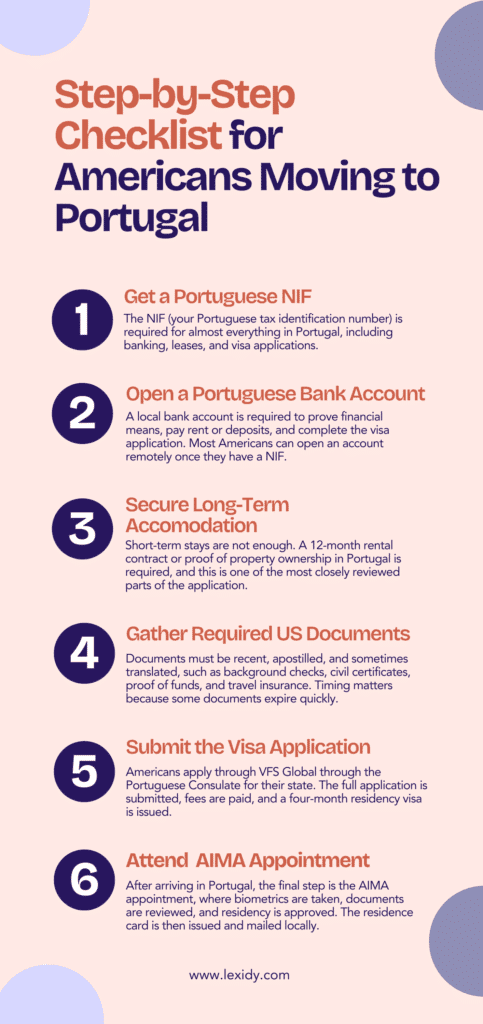
This is where planning turns into action. For anyone moving to Portugal from the USA, the process follows a clear order. Skipping steps or doing them too late is one of the most common causes of delays.
1. Get a Portuguese Tax Number (NIF)
The NIF is required for almost everything in Portugal, including banking, leases, and visa applications.
- Can usually be obtained remotely
- Often handled through a legal representative
- No travel required
This is typically the first step.
2. Open a Portuguese Bank Account
A local bank account is required to:
- Show financial means
- Pay rent or deposits
- Complete the visa application
Most Americans open an account remotely once they have a NIF.
3. Secure Long-Term Accommodation
Short-term stays are not enough. You will need:
- A 12-month rental contract, or
- Proof of property ownership in Portugal
This is one of the most scrutinized parts of the application.
4. Gather Required U.S. Documents
Documents must be recent, apostilled, and sometimes translated. Common requirements include:
- FBI background check (apostilled)
- Birth and marriage certificates (apostilled)
- Proof of income/savings/investments
- Travel insurance
Timing matters here. Some documents expire quickly.
5. Submit the Visa Application
Americans apply through VFS Global, which works with the Portuguese Consulate covering their state of residence. At this stage:
- The full visa file is submitted
- Fees are paid
Once approved, a residency visa is placed in the passport, usually valid for four months, and allows for one extra entry during its validity period.
6. Attend the AIMA Appointment
After arrival in Portugal, there is one final critical step: attend your AIMA appointment to finalize your residency. What happens:
- Biometrics are collected
- Original, updated (if necessary) documents are reviewed
- The residence permit is approved
Once approved, the residence card is issued and mailed locally.
Pros and Cons of Moving to Portugal from the USA
Moving abroad is never just about the visa. Daily life, costs, and administration matter just as much. Before making the decision, it helps to weigh the real advantages against the practical challenges Americans often face after relocating to Portugal.
| Pros (The Draw) | Cons (The Reality Check) |
| Safety: Portugal consistently ranks among the safest countries globally, with low violent crime and a calm daily pace of life. | Bureaucracy: Administrative processes are slow, paper-heavy, and often inconsistent. Appointments can take months. |
| Lower Cost of Living: Overall cost of living is roughly 35–40% lower than in the U.S., especially for rent outside major cities. | Tax Complexity for Americans: U.S. citizens must still file U.S. taxes and report foreign accounts. New arrivals no longer benefit from the NHR regime. |
| Affordable Healthcare: Access to public healthcare plus high-quality private care at a fraction of U.S. costs. | Housing Pressure: High demand and limited supply in Lisbon, Porto, and the Algarve drive rents up and reduce availability. |
| Climate and Lifestyle: Mild winters, warm summers, outdoor living, and a relaxed social culture. | Lower Local Wages: Portuguese salaries are significantly lower than U.S. standards, making local employment unattractive for many expats. |
| English Widely Spoken: High English proficiency, especially in cities and expat hubs, makes integration easier. | Administrative Learning Curve: Systems and expectations differ from the U.S., requiring patience and adaptation. |
Portugal offers strong lifestyle and safety advantages, but it rewards preparation. Americans who plan for taxes, housing, and bureaucracy tend to transition smoothly. Those expecting a fast, U.S.-style administrative pace often struggle early on.
Full Cost of Moving and Living in Portugal (Realistic Budget Guide)

One of the biggest questions Americans have when planning a move is simple: how much does it really cost? While Portugal is generally more affordable than the U.S., expenses vary widely depending on lifestyle, location, and how the move is handled.
The breakdown below shows realistic one-time relocation costs and ongoing monthly expenses, so expectations are grounded in real numbers rather than estimates.
| Cost Category | What This Covers | What to Expect (USD / EUR) |
| International shipping | Sea freight for a 1–2 bedroom household | $3,000–$6,000 one-time |
| Flights (one-way) | Economy class from the U.S. to Portugal | $600–$1,200 per person |
| Visa application fees | Residency visa filing fees | ~€110 per applicant (Visa); ~€180 per applicant (Residence Permit) |
| Legal & setup services | NIF, bank account, visa prep, coordination | €1,000–€3,000 (typical) |
| Rental deposit + advance rent | Usually 1–2 months deposit + 1–2 months rent | €2,400–€6,000+ depending on city |
| Initial furnishings & setup | Furniture, appliances, basic household items | €1,500–€3,000 |
| Monthly living costs (excluding rent) | Food, transport, utilities, insurance, internet | €750–€1,000 per month (single adult) |
| Rent (Lisbon / Porto) | 1-bedroom apartment | €1,000–€1,500 per month |
| Rent (smaller cities / inland) | 1-bedroom apartment | €600–€900 per month |
| Healthcare (private insurance) | Private coverage for expats | €40–€100 per month |
| Public transportation | Monthly metro/bus pass | €30–€50 per month |
| Utilities & internet | Electricity, water, gas, internet | €120–€200 per month |
What a realistic budget looks like
Single adult in Lisbon
- Rent: €1,200
- Living costs: €900
- Total monthly budget: ~€2,100
Single adult outside major cities
- Rent: €750
- Living costs: €850
- Total monthly budget: ~€1,600
Families should expect higher housing and schooling costs, but daily expenses scale reasonably well.
Need Legal Support Moving to Portugal from the USA?
For many Americans, moving to Portugal from the USA is appealing for its safety, lifestyle, and overall affordability. Still, it requires planning. A residency visa is mandatory, income rules must be met, and upfront relocation costs are often higher than expected.
Portugal offers several clear pathways, including the D7, D8, D2, and Golden Visa, each suited to different profiles. The key is choosing the route that matches how income is earned and how life in Portugal is expected to look. When that choice is right, the process is far more predictable.
Costs vary mainly by location and housing choices, while healthcare and daily expenses are usually much lower than in the U.S. With realistic expectations and early preparation, moving to Portugal from the USA can be a smooth and rewarding transition rather than a stressful leap.
Not sure which visa fits your situation or whether you meet the requirements? Our experienced immigration lawyers in Portugal are here to help. Fill out the form below to get clear guidance on your options and next steps.