 Skip to content

The Entrepreneur Visa in Spain is a specialized residence permit designed for non-EU citizens who plan to launch an innovative business project that contributes to Spain’s economy and technological development.
This visa shouldn’t be confused with the Self-Employed Visa, which suits freelancers and small business owners, or the Digital Nomad Visa, aimed at remote workers serving foreign clients. The Entrepreneur Visa specifically targets high-impact startups—for example, ventures with the potential for growth, job creation, and technological innovation.
As part of Spain’s broader push to attract international talent and investment, this visa provides a fast-track route to residency for entrepreneurs who can demonstrate the viability, innovation, and scalability of their projects.
In this blog, we will provide a complete guide to the Entrepreneur Visa Spain in 2025. Read on as we detail its key requirements, the step-by-step application process, benefits, and common mistakes to avoid when applying.
Table of Contents
Entrepreneur Visa Spain Requirements

The Entrepreneur Visa in Spain is granted only to applicants who can present a solid, innovative, and economically beneficial project. Each application is assessed on its individual merit, but the following are the core eligibility requirements every entrepreneur must meet in 2025.
1. The Entrepreneur Visa Spain Business Plan
The Entrepreneur Visa Spain business plan is the cornerstone of your application. It must clearly demonstrate that your venture is innovative, viable, and of special economic interest to Spain.
A strong business plan should include:
- Project Description: Explain your product or service, its objectives, and how you are addressing a specific need or gap in the market.
- Market Analysis: Provide detailed research on the target market, competitors, and growth potential within Spain and beyond.
- Financial Projections: Include expected revenues, expenses, and funding sources to prove sustainability.
- Innovative Value: Outline what makes your idea technologically or conceptually unique and how it contributes to Spain’s economy or innovation ecosystem.
The business plan must be evaluated and approved by ENISA (Empresa Nacional de Innovación S.A.). This is a state-owned agency, responsible for verifying that the project meets the legal standards of innovation and economic interest.
2. Financial Solvency
Applicants must show financial solvency. This is necessary to prove that they can sustain themselves and their dependents while living in Spain.
Minimum financial thresholds (2025):
- Main applicant: 200% of the Spanish Minimum Interprofessional Salary (this works out at roughly €31,752 per year).
- Spouse: An additional 75% of the minimum salary.
- Dependent child: An additional 25% for each dependent child.
Some Spanish consulates may request higher proof of funds, depending on the location and case complexity. Acceptable evidence of funds includes bank statements, investment portfolios, or proof of business capital.
3. Professional Profile
Applicants must demonstrate that they have the academic background, entrepreneurial experience, or industry expertise necessary to execute the business plan.
This may include:
- University or postgraduate qualifications relevant to the proposed activity.
- Proven track record in business management or in the specific industry of the venture.
- Evidence of previous projects, partnerships, or patents.
4. Other General Requirements
Alongside the business and financial elements, all applicants must meet the following standard visa conditions:
- Be at least 18 years old.
- Provide lifelong criminal records from the countries you have legally resided in over the past few years.
- Have comprehensive private health insurance from a provider authorized to operate in Spain (if you are not registered with social security as a business owner).
- Possess a valid passport with at least one year of validity remaining.
- Pay the applicable visa processing fee, as required by the Spanish consulate or immigration office.
Together, these requirements ensure that only genuine, qualified, and financially capable entrepreneurs are granted the opportunity to establish innovative ventures in Spain.
Not sure if you qualify? Our experienced team of immigration lawyers are here to help you understand the full requirements and guide you toward the right visa for your circumstances.
The Two-Stage Entrepreneur Visa Spain Application Process
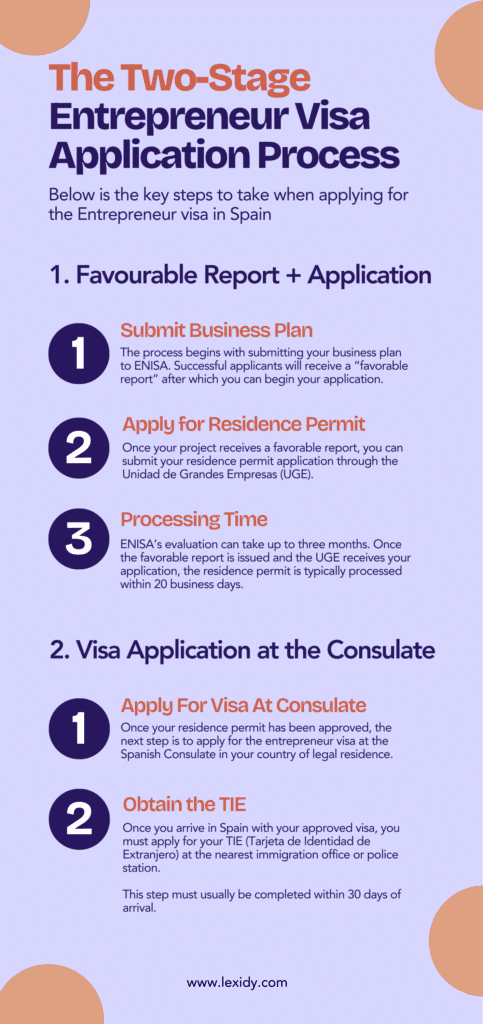
Unlike other residence categories, the Entrepreneur Visa Spain involves a two-stage approval process. This structure ensures that both your business idea and your legal residence are thoroughly evaluated before you relocate. Let’s take a look at the steps involved.
Stage 1: The Favorable Report & Residence Permit Application
The first stage focuses on validating the business project and securing the residence permit.
1. Submit the Business Plan for Evaluation
The process begins with submitting your business plan to ENISA (Empresa Nacional de Innovación S.A.). ENISA evaluates whether your idea qualifies as innovative and of special economic interest to Spain. Successful applicants will receive a “favorable report”.
Once your project receives a favorable report, you can submit your residence permit application through the Unidad de Grandes Empresas (UGE). This is Spain’s Large Companies and Strategic Groups Unit.
- The application is typically filed from abroad, but in certain cases, you can apply from within Spain (for example, if you’re already legally residing in the country).
- Supporting documents typically include proof of financial means, health insurance, a criminal record certificate, and the approved business plan.
3. Processing Time
- ENISA’s evaluation can take up to three months, depending on the complexity of the project.
- Once the favorable report is issued and the UGE receives your application, the residence permit is typically processed within 20 business days. That makes this one of the fastest turnaround times for a visa under Spanish immigration law.
Stage 2: The Visa Application at the Consulate
Once your residence permit has been approved, the next step is to apply for the entrepreneur visa at the Spanish Consulate in your country of legal residence.
- This stage primarily involves verifying your identity, collecting biometric data, and confirming your eligibility to travel.
- The entrepreneur visa issued by the consulate is typically valid for one year and allows you to enter Spain to activate your residence permit.
Post-Arrival in Spain: Obtaining the TIE
Once you arrive in Spain with your approved visa, you must apply for your TIE (Tarjeta de Identidad de Extranjero) at the nearest immigration office or police station.
This step must usually be completed within 30 days of arrival. The TIE will be your foreign identity card, and serves as your official proof of residence in Spain, enabling you to reside and operate your business legally.
Together, these two stages form the backbone of the Entrepreneur Visa Spain process. These 2 mandatory stages ensure that only genuinely innovative and economically impactful ventures are welcomed into Spain’s startup ecosystem.
Benefits of the Entrepreneur Visa in Spain

The Entrepreneur Visa in Spain offers one of the most attractive residence options in Europe for innovators, investors, and startup founders. Beyond facilitating the launch of your business, it provides long-term stability and flexibility for you and your family. The main benefits include:
Fast-Track Process
Unlike traditional work visas, the entrepreneur visa is processed under Spain’s Ley de Emprendedores (Entrepreneurs’ Law). This framework was designed to fast-track applications for highly qualified talent. Residence permits through the Unidad de Grandes Empresas (UGE) are typically issued within 20 business days. The short timeline for the approval process provides a clear advantage for entrepreneurs seeking quick market entry.
Initial 3-Year Validity
Once approved, the initial residence permit is valid for three years, offering greater stability than many other visa types. After three years, it can be renewed for two further years, provided your business remains operational and continues to meet its initial objectives.
Family Inclusion
One of the most appealing features of the Entrepreneur Visa in Spain is that family members can apply simultaneously. The applicants’ spouse or registered partner, dependent children, and even financially dependent parents are eligible to apply. This allows your family to move with you from the outset, enjoying the same rights to live, study, and work in Spain.
Flexibility
Spain’s Entrepreneur Visa grants full freedom to live and work in Spain, whether you choose to focus exclusively on your startup or pursue other professional ventures. It also allows travel throughout the Schengen Zone without additional visas, providing excellent mobility within Europe.
Path to Citizenship
The entrepreneur visa serves as a stepping stone to permanent residency and Spanish citizenship. After five years of continuous legal residence, you can apply for permanent residency. After a total of ten years, you can apply for Spanish citizenship, provided you meet all integration and legal requirements.
In summary, the Entrepreneur Visa Spain can be viewed as a gateway to building an innovative business, establishing long-term roots, and eventually gaining access to EU citizenship benefits.
Common Mistakes and How to Avoid Them
Even strong applications for the Entrepreneur Visa Spain can fail due to avoidable errors. Understanding the most common mistakes can significantly improve your chances of approval and help you navigate the process with confidence. Here are the most common mistakes we see:
Weak Business Plan
The business plan is the foundation of your application. Its quality directly determines whether you receive a favorable report from ENISA. The most common reason for a rejected application is a plan that lacks innovation, scalability, or economic benefit to Spain.
To avoid this, ensure your proposal clearly defines the market gap your business will address, outlines measurable growth potential, and highlights how it contributes to Spain’s economy or technology landscape.
Incorrect Documentation
Every document submitted must meet Spanish legal standards. A frequent cause of delays or denials is failing to legalize, translate, or apostille required documents. The most common documents we see this happen with include birth certificates, diplomas, or criminal records.
Before submission, double-check that all paperwork has been properly certified and officially translated into Spanish by a sworn translator (traductor jurado).
Underestimating Financials
Applicants sometimes overlook the importance of showing adequate financial resources. You are not only required to account for living expenses but also for the early stages of their business. Failing to demonstrate sufficient solvency can result in rejection.
To avoid this, provide clear evidence of both personal savings and startup capital, ideally through recent bank statements, investment records, or funding agreements.
Choosing the Wrong Visa
Not all entrepreneurs coming to Spain require the Entrepreneur Visa. Some may find that the Self-Employed Work Visa or the Digital Nomad Visa better fits their business model. Applicants should consider these options if their project isn’t classified as innovative or doesn’t meet ENISA’s standards. Before applying, review each visa type carefully or consult with a Spanish immigration lawyer to ensure you choose the most suitable route.
Navigating the Entrepreneur Visa Spain process can be complex, especially when preparing the business plan and ensuring your documents meet legal standards. If you want expert guidance to avoid these common pitfalls, explore our immigration services in Spain today.
Ready to Apply for the Entrepreneur Visa in Spain?
The Entrepreneur Visa Spain is one of the most forward-thinking immigration routes available to non-EU innovators and startup founders. While the process demands a strong business plan, thorough documentation, and clear proof of financial and professional credibility, the rewards are significant, from fast-track residence rights to a long-term path toward Spanish citizenship.
If you’re ready to begin your application or want expert legal support to prepare your business plan and ENISA submission, our trusted immigration lawyers can guide you through every step of the process. Fill out the form below and we will be in touch!